
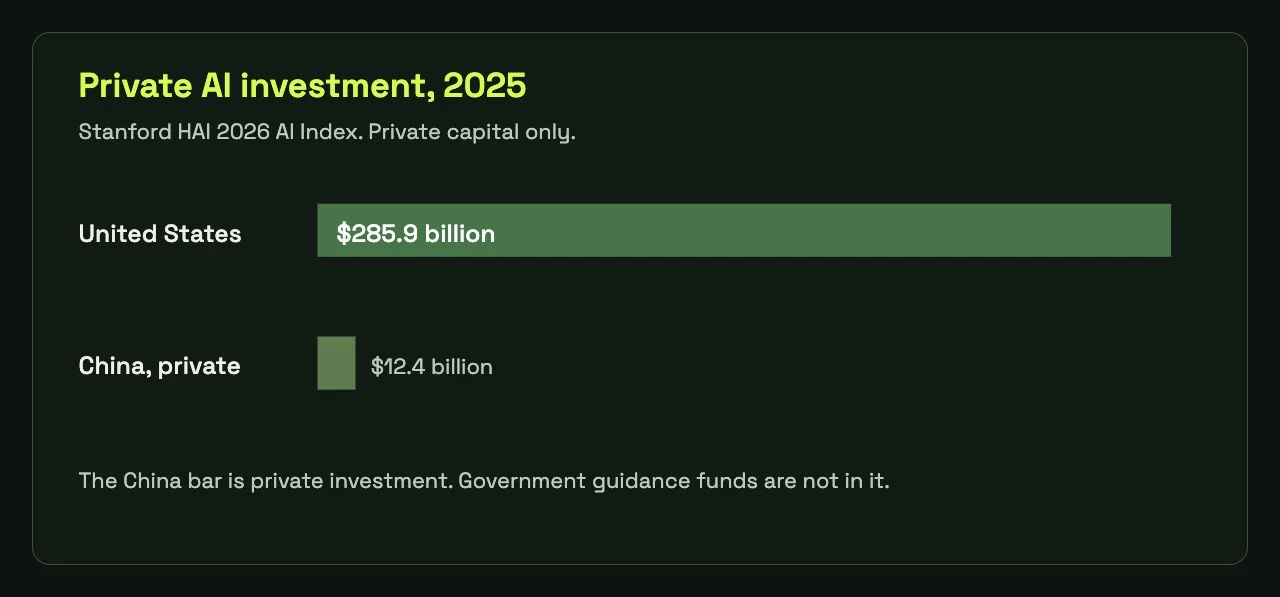
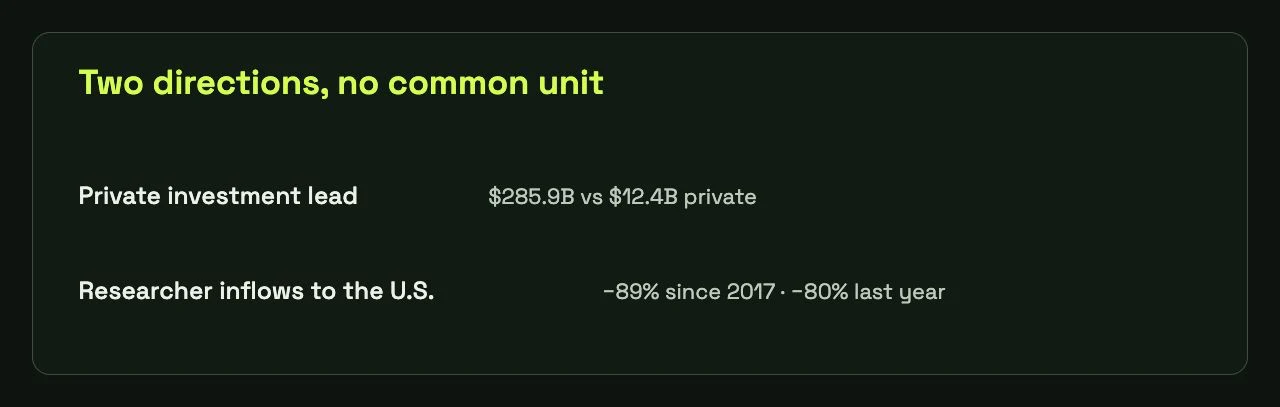
Capital and people are telling different stories, and the 2026 AI Index prints them in the same finding. U.S. private AI investment reached $285.9 billion in 2025, more than 23 times the $12.4 billion invested in China on the same private measure. The Index adds the caveat that matters for anyone using the multiple in a speech: private investment understates China’s total AI spending, because government guidance funds do not show up in that comparison. On the startup count, the United States led with 1,953 newly funded AI companies in 2025, more than ten times the next country.
The talent sentence points the other way. The number of AI researchers and developers moving to the United States has dropped 89 percent since 2017, with an 80 percent decline in the last year alone. A country can be the place the money is raised and a harder place for the people who build the systems to enter. The Index treats that as a fact about the United States’ ability to attract global talent, set beside its investment lead.
Where the dollars went
Elsewhere in the Index’s economic findings, private investment grew fastest inside the global mix, and generative AI captured a large share of private funding. Organizational adoption reached 88 percent of surveyed organizations, while agent deployment stayed in the single digits across nearly all business functions. The money and the org chart are both moving, and they are not moving into the same kind of system. Funding can build a model company. Adoption, on the Index’s cut, is still mostly something other than an autonomous agent.
A second spending picture, from executives rather than venture tables, lines up with concentration. NBER Working Paper 34836 says U.S. firms expect to spend about $2,000 per employee on AI in 2026, implying around $300 billion in aggregate annual firm spending, with 2 percent of firms accounting for over half of that spending. Venture investment and operating expenditure are different pots. Both pots, on these sources, are uneven. A regional economic-development office that quotes the $285.9 billion as if it were spread across the firm distribution is reading the wrong table.
Hiring against a shrinking inflow
The 80 percent one-year drop in inbound AI researchers and developers is a labor-supply fact for every lab and every product group that assumed the next cohort would relocate. The Index also notes that new AI PhDs in the United States and Canada rose 22 percent from 2022 to 2024, and that the PhDs who made up that increase took academic jobs rather than industry jobs. Domestic doctoral supply and international mobility are both constrained relative to the capital boom, for different reasons. Industry cannot assume the university increase is its hiring pool, and it cannot assume the 2017 mobility pattern still holds.
There is a consumer-side contrast the Index states in the same report and that does not rescue the talent gap. Generative AI reached about 53 percent population adoption within three years, faster than the personal computer or the internet on the Index’s comparison, while the United States ranks 24th at 28.3 percent. Singapore is at 61 percent and the United Arab Emirates at 64 percent. Adoption by the public and relocation of researchers are different flows. A large home market for users can coexist with a sharp drop in the number of specialists moving in. Firms that hire as if user adoption automatically produced a local research workforce are mixing those flows.
For a company, the useful split is local. Capital markets will keep funding model vendors; the Index’s investment and startup counts say the U.S. center of that financing held in 2025. Staffing a research team is a separate plan: visa timelines, academic competition for new PhDs, and the possibility that the best available people are already in the country and expensive. Treating the investment multiple as a talent multiple is the mistake the finding is built to prevent. The Index even flags that private China figures understate the state’s role, so the multiple is a ceiling on a claim about money and no claim at all about researchers.