
The loud argument about jobs is running ahead of the measured one. NBER Working Paper 34836, “Firm Data on AI,” reports a summer 2026 survey of nearly 9,000 chief executives, chief financial officers, and other senior executives in the United States, the United Kingdom, Germany, Australia, Canada, Mexico, and South Africa. The abstract’s labor findings are easy to under-read because the adoption finding next to them is large. Seventy-eight percent of firms use AI. Eighty percent of executives say they use it regularly. Average use is 2.1 hours a week, up from 1.5 hours a week in the winter 2026 wave.
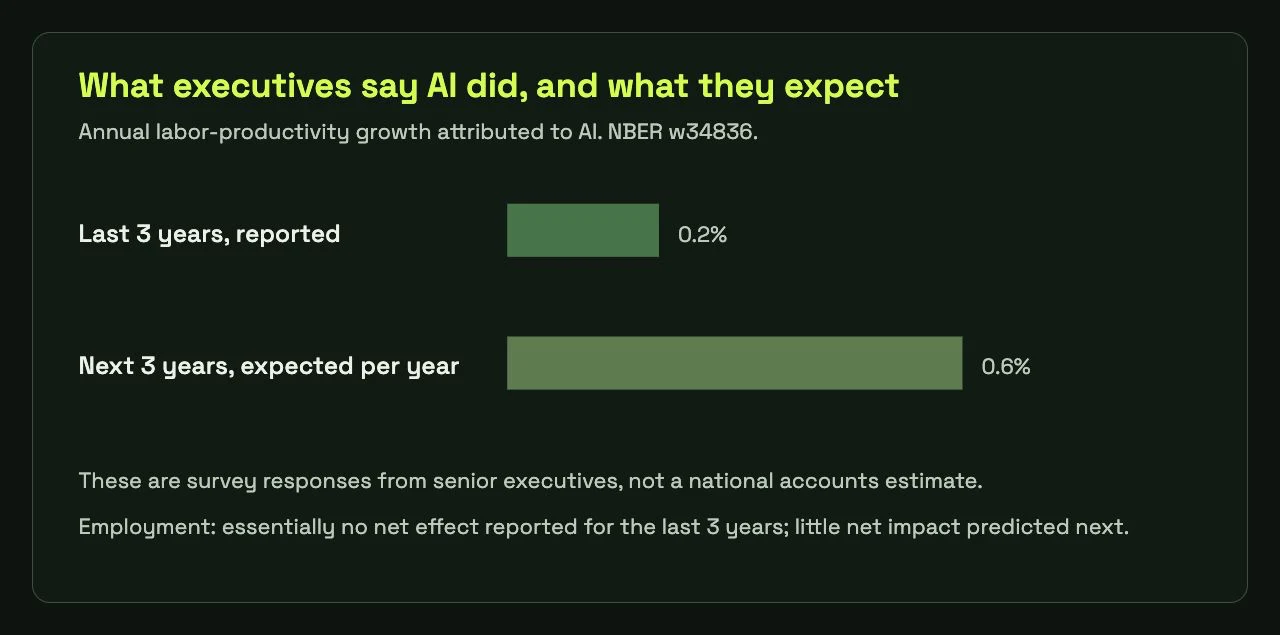
On employment, the same executives report essentially no net effect over the last three years, and they predict little net impact over the next three. The paper says those small net effects hide churn. More than 40 percent of firms anticipate positive or negative employment effects that roughly offset only when firms are added together. On productivity, executives report that AI adoption raised annual labor-productivity growth by 0.2 percent over the last three years. They expect a 0.6 percent a year boost over the next three. Past and forecast are both executive reports. They are not a statistical agency’s productivity residual.
Spending is lumpy, and so is the job story
The abstract adds a concentration fact that should sit next to any workforce plan. U.S. firms in the survey expect to spend about $2,000 per employee on AI-related expenditures in 2026, implying around $300 billion in aggregate. Two percent of firms account for over half of total spending. A company at the median is not living in the same capital budget as that tail. Its employment plan should not be copied from the tail’s press release either.
A separate cut, from the U.S. Census Bureau’s Center for Economic Studies, describes an earlier window with a different instrument. Working Paper CES-26-25R, on the 2026 AI supplement to the Business Trends and Outlook Survey, covers November 2025 through January 2026. It finds that 18 percent of firms used AI in a business function, 32 percent on an employment-weighted basis. Most users, 66 percent, relied on AI solely to augment tasks. AI-related employment decreases were rare, occurring in 2 percent of firms, and tended to concentrate among large firms and firms using AI to substitute for tasks. That paper and the NBER abstract agree on the shape — little net cutting so far, more happening inside large firms — and they disagree on levels, because they ask different people different questions. The measurement briefing in this series is about that disagreement. This one is about what the labor answers say once you keep the instrument attached.
Experts and the public are not in the same meeting
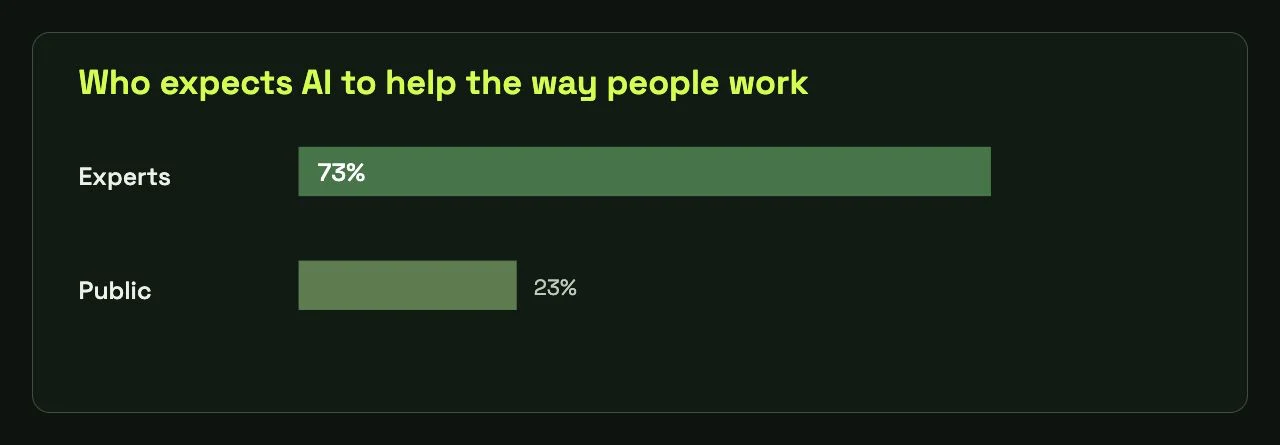
Stanford’s 2026 AI Index reports a perception gap that will walk into every all-hands. On how AI affects people’s jobs, 73 percent of experts expect a positive impact, compared with 23 percent of the public, a 50-point gap. Similar divides show up for the economy and for medical care. A leadership team that briefs the 0.6 percent productivity hope without the churn sentence — more than 40 percent of firms expecting gains and losses that wash out only in total — will sound like the experts in that split. Employees have already heard a different forecast from somewhere else.
The planning use of this evidence is modest, which is the point. Do not staff a three-year plan on a headline that says AI has already cut the workforce; these two serious surveys do not say that. Do not staff it on a promise that the next three years are a 0.6-point gift with no reallocation; the same executives say the firm-level employment bets are large and opposite. Track hours of executive use if you want a leading indicator that is actually moving: from 1.5 hours a week in the winter wave to 2.1 in the summer. And when someone quotes a single adoption percentage, ask which survey. The labor story is legible only after that question.