
Anyone who needs a single adoption number for a board slide is going to be disappointed, and the disappointment is useful. In June 2026, economists at the Federal Reserve Bank of St. Louis walked through why U.S. firm surveys and European firm surveys had been talking past each other. The Census Bureau’s Business Trends and Outlook Survey had asked whether a firm used AI in producing goods or services. Eurostat’s enterprise survey asked about a list of AI technologies for any business purpose. In Europe, production was only about 21 percent of the uses among firms that used AI. Marketing and sales, and the organization of business processes, were more common.
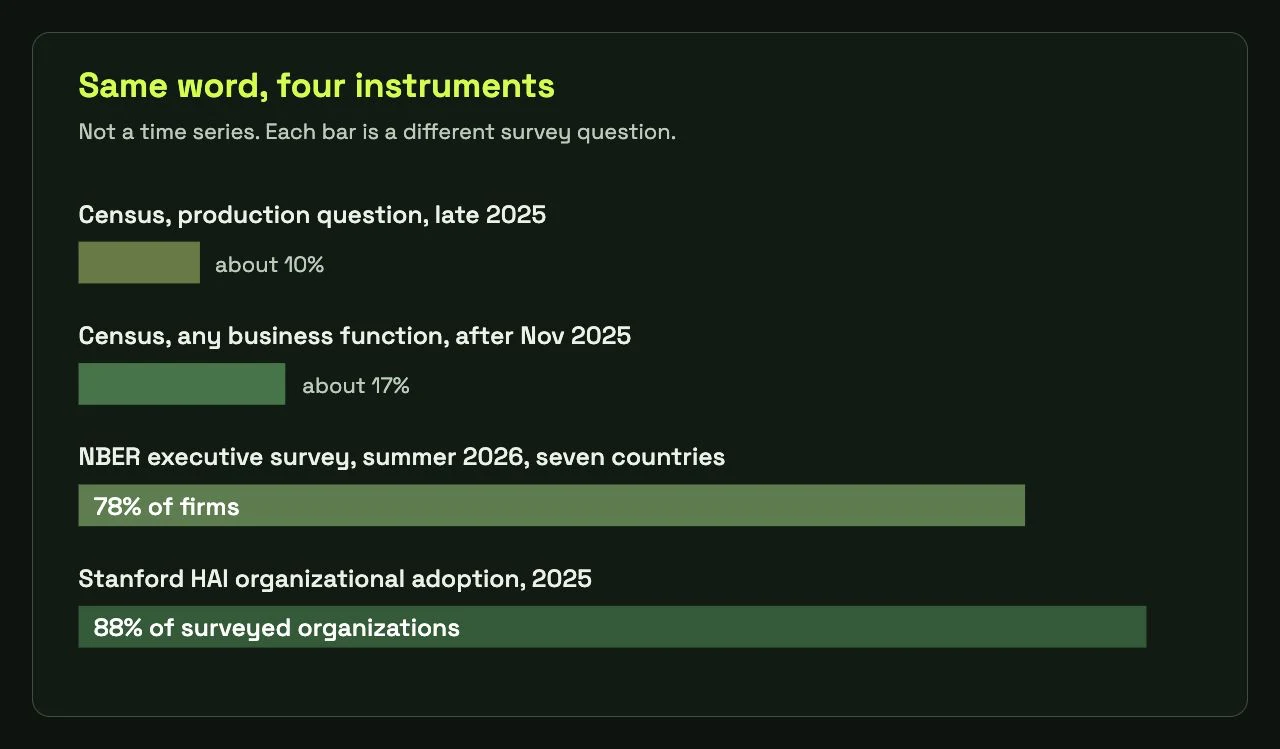
The Census Bureau changed its question in November 2025, from production to “any of its business functions.” The St. Louis Fed authors report that measured use had climbed to about 10 percent under the old wording by late 2025, then almost doubled to 17 percent after the change. They are explicit: the jump is a change in what was counted. Firms were reporting marketing, administration, and finance uses the old question missed. Even then, 17 percent sat below the rate the authors’ crosswalk with Europe would have predicted. Question design still leaves a gap.
Executives answer a broader question
The summer 2026 wave described in NBER Working Paper 34836 surveys nearly 9,000 chief executives, chief financial officers, and senior executives in the United States, the United Kingdom, Germany, Australia, Canada, Mexico, and South Africa. The abstract’s first fact: 78 percent of firms use AI. U.S. firms in that survey expect to spend about $2,000 per employee on AI-related expenditures in 2026, which the authors scale to around $300 billion. Spending is concentrated. Two percent of firms account for over half of it.
That paper and the Census survey can both be careful and still disagree. BTOS is a large, repeated sample of U.S. employer businesses, with a short questionnaire and a two-week reference window. The Census Bureau’s April 23, 2026 release said new AI supplements ran from November 17, 2025, to February 8, 2026, and that results are representative of employer businesses excluding farms. The NBER effort is an executive survey across countries, weighted and worded differently. Stanford’s 2026 AI Index reports yet another cut: organizational adoption reached 88 percent in 2025, while generative AI was in at least one business function at 70 percent of organizations, and AI-agent deployment stayed in the single digits across nearly all functions.
Earnings calls add a unit the surveys do not have
On November 1, 2026, CNBC reported that Santander had tied €194 million, about $216 million, of “business value” to AI initiatives in the first nine months of 2026. Chief financial officer José García Cantera told the network this was a quarter in which the bank could link a positive contribution directly to AI, affecting both revenue and costs. He also said the technology is embedded widely enough that isolating a single figure is difficult.
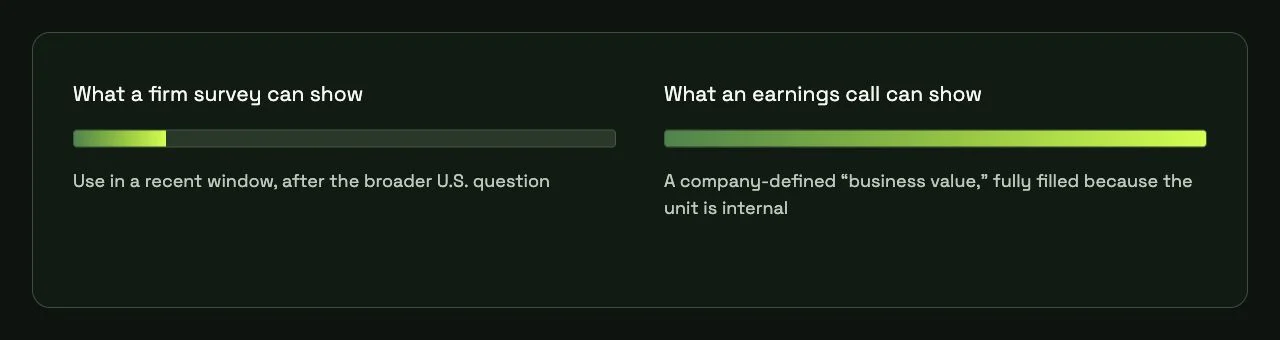
“Business value” is a management metric. It is not the 17 percent, the 78 percent, or the 88 percent. A board can hold all four numbers if the footnote stays attached. Drop the footnote and the company will sound, in the same afternoon, like a laggard in the Census tables and a pioneer on the earnings call.
How to brief it
Pick the population first. If the question is “what share of U.S. employer firms used AI in any function during a recent two-week window,” start with BTOS and read the St. Louis Fed note before comparing the series to 2024. If the question is “what do senior executives in several countries say they spend and expect,” use the NBER paper and keep the concentration fact next to the adoption fact. If the question is “what did a named company book,” use the company’s own words and refuse to convert euros of business value into a productivity residual.
The St. Louis Fed’s point travels past this one revision. Worker surveys had put on-the-job AI use far above the old firm rate, and a small industry of papers treated the gap as economics. A large piece of it was the form. The next argument, in banking and elsewhere, is whether post-deployment controls are as common as the policies. That is a different measurement problem, and it has its own primary source.