
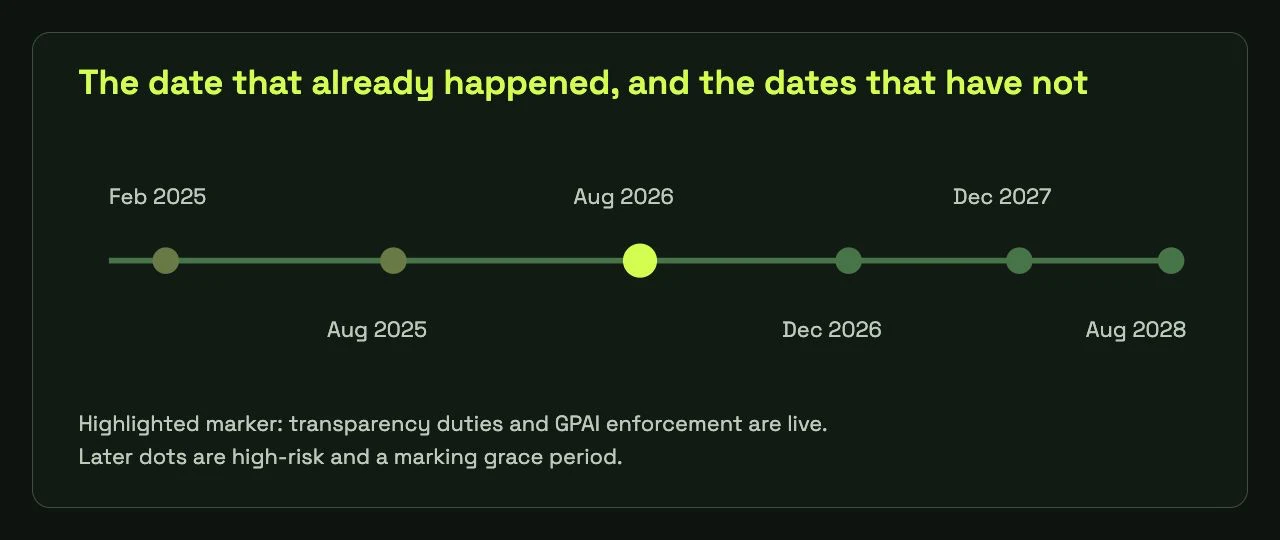
The European Commission’s AI Act page describes a calendar that is easy to flatten into “the AI law starts later.” The regulation entered into force on August 1, 2024. Prohibited practices and AI-literacy duties have applied since February 2, 2025. General-purpose model obligations have applied since August 2, 2025. From August 2, 2026, the AI Office and member-state authorities supervise and enforce, and the Commission’s enforcement powers over general-purpose models are in effect. High-risk uses in sensitive areas, including biometrics, critical infrastructure, education, employment, and migration, apply from December 2, 2027. High-risk AI embedded in regulated products applies from August 2, 2028. Those later dates are the product of the AI Omnibus, which entered into force on July 27, 2026.
Transparency does not wait for 2027. The Commission says the transparency rules come into effect in August 2026. People should be told when they are interacting with a machine, so they can decide what to do with that fact. Providers of generative AI have to make AI-generated content identifiable. Deepfakes, and text published to inform the public on matters of public interest, are called out for clear labeling. The AI Act Service Desk adds a transition detail: providers of systems placed on the market before August 2, 2026, have until December 2, 2026, to comply with the marking and detection duty in Article 50(2).
What “label it” means in a newsroom
The Commission’s guidelines on transparency obligations spell out the split between providers and deployers. Providers design systems so people are told when they are interacting directly with AI, and they add machine-readable marks so generated or manipulated content can be detected. Deployers tell people when they are exposed to emotion recognition, biometric categorization, deepfakes, or — for text on matters of public interest — publication without human review or editorial control. A news organization that uses a model to draft and then runs a human edit is in a different posture from one that publishes the draft as public-interest text with no editorial control. The guideline is about that difference. It is also about chatbots on the subscription page, synthetic voice in a podcast promo, and images that are cheaper to generate than to assign.
Compliance can be shown by following the Code of Practice on marking and labeling AI-generated content, which includes icons for image, audio, and text. The code is voluntary. Providers and deployers who do not sign on still have to show equivalent means for marking and labeling. For the other transparency duties, such as telling a person they are talking to a machine, the guidelines say organizations choose adequate measures themselves, with the guidelines as the reference.
The rest of the company is on this clock too
A manufacturer waiting for the 2028 product rules can still have a customer-service bot and a marketing image generator in market today. Those systems pick up the August duties even when the machine they help sell does not yet pick up high-risk product duties. Emotion-recognition features in a workplace or a school were already in the prohibited set from February 2025; the transparency duty for emotion recognition that is still lawful is an additional labeling problem, not a permission slip.
Enforcement is no longer theoretical. From August 2, 2026, national market-surveillance authorities, the AI Office for the systems it supervises, and the European Data Protection Supervisor for EU institutions are responsible for these transparency rules. A U.S. publisher with EU readers, or a retailer with an EU storefront, has a production change to make: a field in the content system for “was this generated,” a rule for when a human editor’s pass changes the label, and a machine-readable mark that does not depend on a caption someone can delete. The high-risk conformity file can wait its turn. The label cannot.