
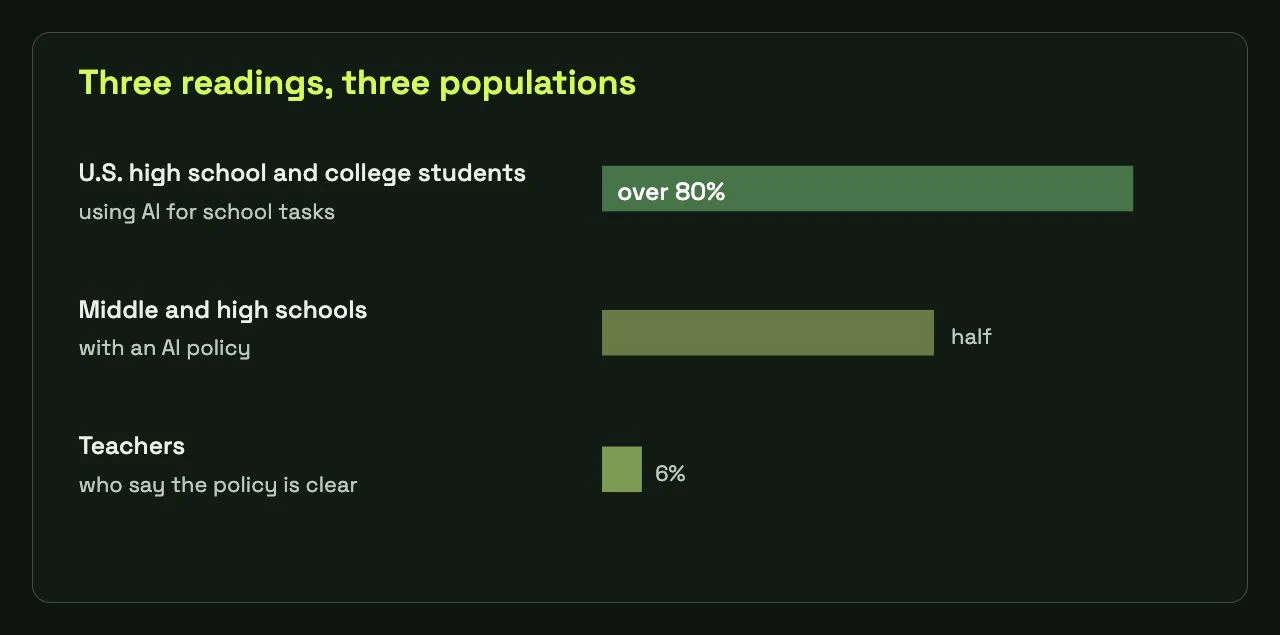
Companies keep writing acceptable-use policies as if the new hire will encounter a model for the first time in the employee handbook. Stanford HAI’s 2026 AI Index says the encounter already happened. Over 80 percent of U.S. high school and college students use AI for school-related tasks. Four in five university students use generative AI. The same findings say only half of middle and high schools have AI policies in place, and just 6 percent of teachers say those policies are clear.
Those percentages do not share a denominator. “Over 80 percent” is students. “Half” is schools. “Six percent” is teachers judging clarity. Putting them on one chart without labels would fake a single population. Kept apart, they still make one management point: use is normal, rules are partial, and the people asked to enforce the rules mostly do not find them clear.
The hiring pipeline is a policy pipeline
A graduate who used a model to outline essays, check code, and summarize readings will do the same to a memo unless the employer’s rule is more concrete than the school’s. The Index’s teacher result says “be responsible” is not concrete. Six percent clarity is a design failure, not a moral one. Students are not waiting for the design to improve. The Index also says AI engineering skills are accelerating fastest in the United Arab Emirates, Chile, and South Africa, and that the increase in new AI PhDs in the United States and Canada from 2022 to 2024 — 22 percent — went into academic jobs, not industry. The talent story and the student-use story are different. One is about where researchers work. The other is about how ordinary graduates already work.
Formal education, the Index says, is lagging the technology, while people learn AI skills at every stage of life. That sentence is an invitation for employers to stop treating training as a remedial class for the unconvinced. The incoming class is convinced. What it lacks is a shared line between a draft that a person owns and a draft that a person filed.
What to teach in the first week
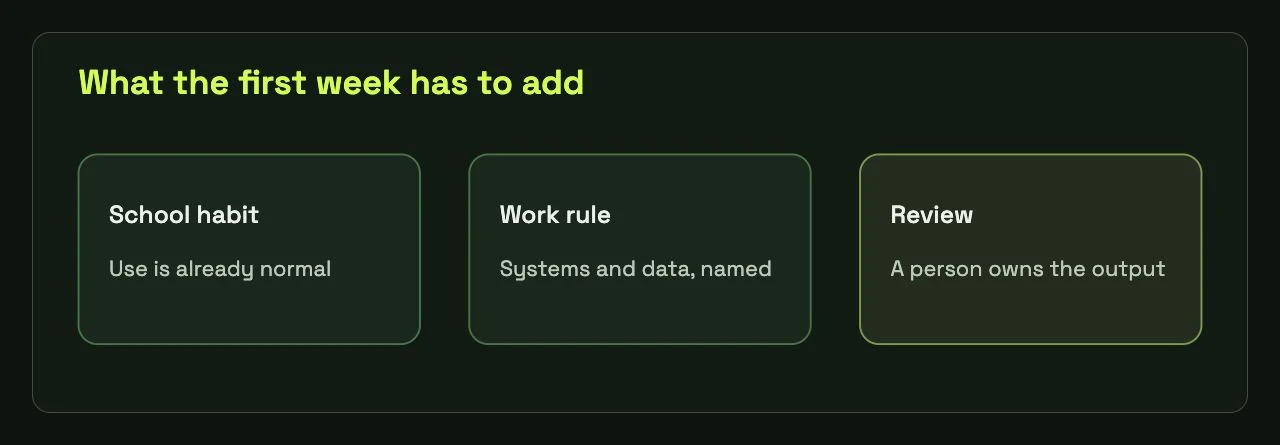
A first-week module that repeats “do not cheat” will miss the actual gap. The school policy, where it exists, was about assignments. The work policy is about clients, logs, and confidential data. Useful rules name systems, name data that may not be pasted into a consumer tool, and name the review a person owes before a model’s paragraph leaves the building. They also show a permitted use, because a ban that half the schools could not even write will not survive contact with an 80 percent habit.
Employers sometimes copy a school’s detection instinct: run student work through a detector and punish the positive. The Index does not evaluate detectors, and this briefing will not invent an accuracy rate for them. The clearer lesson from the policy numbers is that people already use the tools inside institutions whose rules they cannot parse. A detector at the office door repeats that confusion with a different vendor. A written permission, a named system, and a review step are slower to draft and easier to follow than a score nobody can explain.
There is a public-opinion echo. The Index finds that 73 percent of experts expect AI to affect jobs positively, against 23 percent of the public. New hires are closer to the student statistics than to the expert panel. They will arrive fluent and suspicious at the same time: fluent because school already required the fluency in practice, suspicious because the rules around that fluency were muddy. An employer that writes a clear permitted-use page will be offering something many of their teachers did not have. That is a modest advantage. It is also one of the few on this topic that a company can implement before the next model release.