
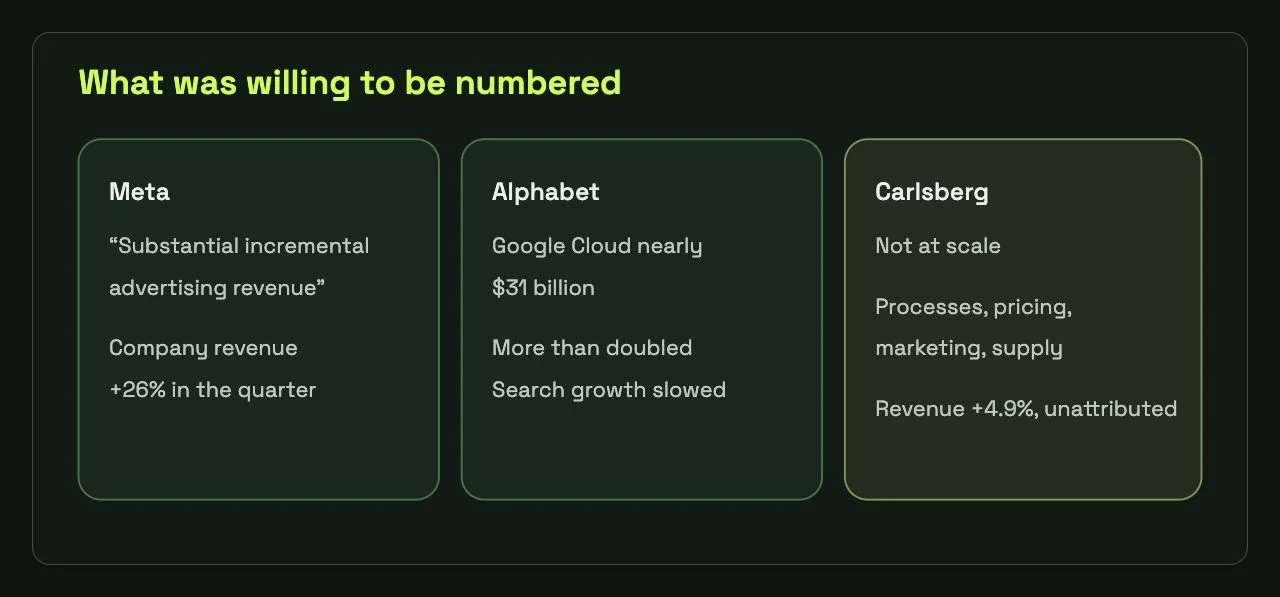
The November 1, 2026 CNBC earnings story is useful because it refuses to average a bank, a drugmaker, a brewer, and two technology platforms into one “AI payoff.” The platform lines are the ones with revenue attached. Meta, in earnings dated October 21, said AI investments were delivering substantial incremental advertising revenue. Total revenue rose 26 percent in the quarter ended September 30. Alphabet, reporting the Wednesday before CNBC’s story, said Google Cloud revenue more than doubled, to nearly $31 billion in the third quarter. Search revenue growth slowed, CNBC noted, amid concern about AI competition.
Set that next to a consumer-goods operator. Carlsberg’s chief executive, Jacob Aarup-Andersen, told Squawk Box Europe that the company is not seeing AI benefits at scale. He said the technology has affected internal processes, cost efficiency, commercial and pricing work, marketing, and the supply chain. Revenue grew 4.9 percent in the third quarter. CNBC does not tie that 4.9 percent to AI. The honest reading is a company that can list the workflows and will not claim the margin.
Advertising and cloud are the meters that already exist
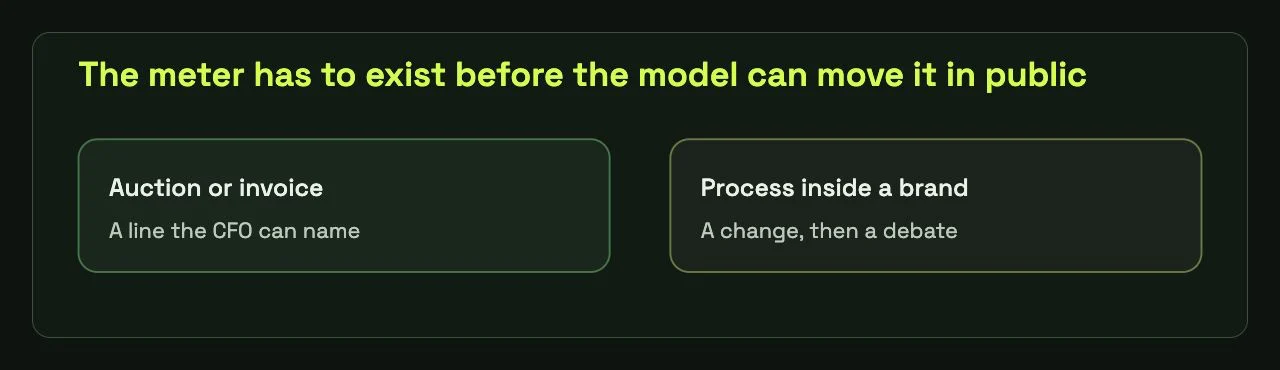
Meta can see an ad auction. Alphabet can see a cloud invoice. A brewer can see a process change and a long argument about whether the process change is the reason a customer ordered. The difference is measurement infrastructure that predates the model. AI did not invent advertising attribution or cloud billing. It landed inside systems that already produced a number a chief financial officer will say out loud. Consumer packaged goods have those systems for media spend and for plant efficiency, and this quarter’s public comment from Carlsberg kept them in the “affected” column.
CNBC’s technology section the same day carried a companion headline, “Why AI is boosting Meta’s ad business while hurting Google search.” The earnings story already contains the two halves: incremental ad revenue at Meta, slower Search growth at Alphabet beside a cloud result that more than doubled. A retailer that buys both ads and cloud should read those as a split in the platform layer, not as a promise that the store’s own chatbot will show up the same way. The store’s chatbot looks, structurally, more like Carlsberg’s marketing process than like an ad auction.
Do not import a platform multiple into a brand plan
Santander, in the same article, did publish an internal figure: €194 million of business value from AI initiatives in nine months. That is a bank’s management metric, discussed in the measurement briefing, and it is still not a cloud invoice. The pattern across non-platform firms is a sentence of contribution plus a refusal to fractionate the profit and loss. The pattern across the two platforms is a revenue line that already had a name.
Search is the awkward middle. Alphabet can report a cloud line that more than doubled and, in the same quarter, a search business whose growth slowed while management and investors argued about AI competition. That is not a consumer brand’s problem, but it is a warning against treating “AI” as a single revenue sign. Inside one company the sign can be positive in cloud and debated in the core adjacencies. A retailer that both buys search ads and sells on a marketplace should ask which of those platform moves changes its traffic, and keep that question separate from whether its own service bot has earned a line in the accounts.
A retail or consumer leadership team can use the week without borrowing Meta’s growth rate. Ask which of your own processes already have a meter as sharp as an ad auction or a cloud bill. Put AI spend against those meters first, and say so. For the rest — the brand marketing tests, the supply-chain tweaks Carlsberg listed — report the operational change and leave the revenue sentence blank until finance will sign it. That is the disclosure standard the brewer just modeled, in public, on the same day the platforms did the opposite.