
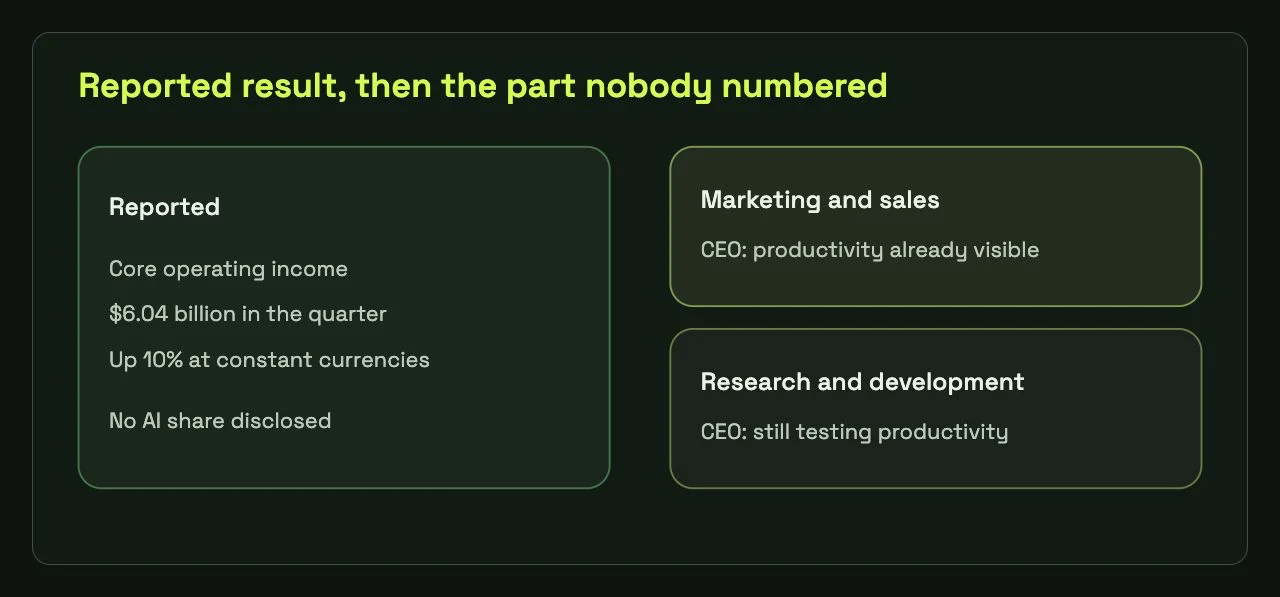
Vas Narasimhan, chief executive of Novartis, sat for CNBC’s Squawk Box Europe during the latest earnings round and said a sentence drug companies have been promising for several years. “I think this is the first quarter I’ve really seen AI start to improve actually our P&L on a tangible basis.” CNBC’s November 1, 2026 account is careful about what followed. Novartis reported third-quarter core operating income of $6.04 billion, up 10 percent year on year at constant currencies. The company did not quantify how much of that was attributable to AI.
Narasimhan then split the work in two. On research and development, he said the company is working to see whether AI can increase productivity. On marketing and sales, he said some of the productivity is already visible in the bottom line. That ordering matters. The romantic version of pharmaceutical AI is a model that proposes a molecule. The version that showed up in this interview is commercial execution: who gets called on, with what material, at what cost to serve.
Peers are making the same kind of claim
The same CNBC piece gathers three other management comments from the week, and they rhyme. Santander said AI initiatives generated €194 million of business value in the first nine months of 2026. The bank’s chief financial officer, José García Cantera, said the quarter let the bank link a positive contribution directly to AI, across revenue and costs, and also said it is hard to isolate how much of any process is the model. Standard Chartered’s chief financial officer, Manus Costello, said AI “appears everywhere,” that third-quarter operating income grew 14 percent at constant currency excluding notable items, and that income is growing faster than costs partly because AI tools let the bank scale processes. He did not publish an AI line in the accounts. Carlsberg’s chief executive, Jacob Aarup-Andersen, said the company is not seeing benefits at scale. He did say internal processes, pricing, marketing, and the supply chain have been touched. Carlsberg’s revenue grew 4.9 percent in the quarter. CNBC does not attribute that growth to AI.
Read together, the week is evidence of a reporting style, not of a common rate of return. A handful of large firms are willing to say the profit and loss has moved. Almost none are willing to say by how many basis points. The honest use of these interviews is as disclosure of management attention. The dishonest use is as a benchmark a mid-size manufacturer can paste into a capital plan.
Why commercial AI shows up first
Marketing and sales data are already structured around a customer, a message, and an outcome the finance team recognizes. A field force that writes fewer unused slides, or a pricing desk that revises faster, can land in a quarter. A discovery program lands on a different clock. A molecule that looks better in a model still has to survive experiments, trials, and regulators. Narasimhan’s split matches that clock. He did not claim the pipeline had suddenly become an AI pipeline. He claimed the commercial engine had started to show a tangible contribution, and he left the size unstated.

What a pharma buyer should ask next
Three questions follow from the interview without inventing a number the company withheld. First, which commercial processes does management believe moved the quarter, and what was the baseline cost or yield? Second, what would falsify the R&D hope in the next year — a cycle-time metric, a hit rate, a decision to stop a program? Third, which of these tools are third-party models whose behavior can change without a protocol amendment? That last question is the one UK bank supervisors are already asking of financial firms, and it applies to a medical-affairs chatbot as cleanly as to a credit model.
Stanford’s 2026 AI Index added a science chapter and kept a medicine chapter, a sign that the research community now treats scientific use as a measurable field of its own. The Novartis comment is the enterprise counterpart: science use and commercial use do not arrive as one return. A company can be early on the profit and loss and still early, in the ordinary sense, on the science.