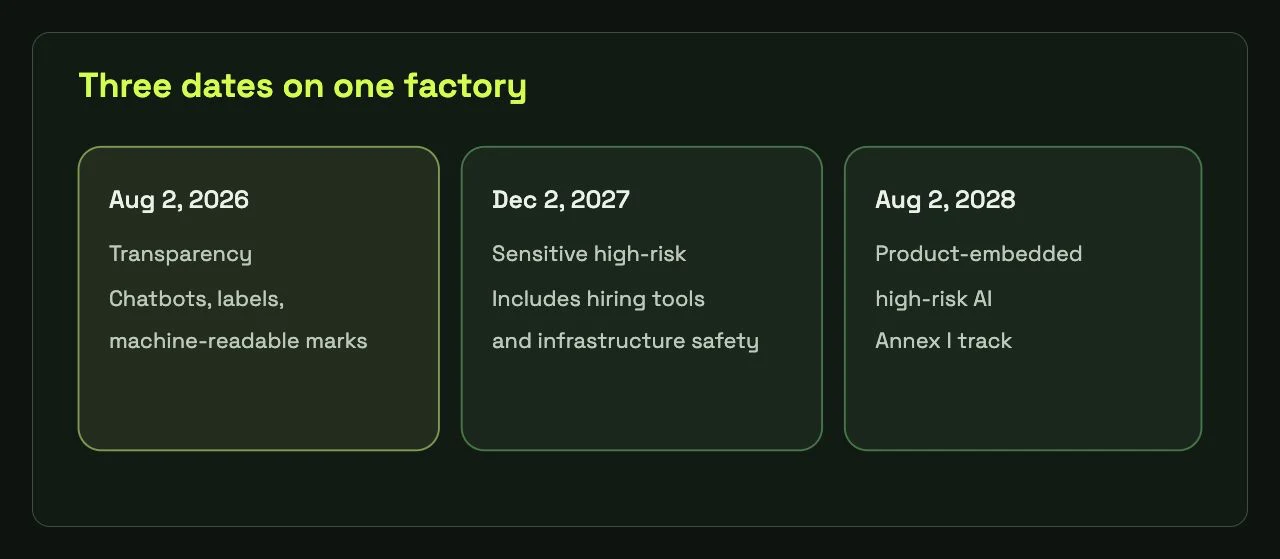
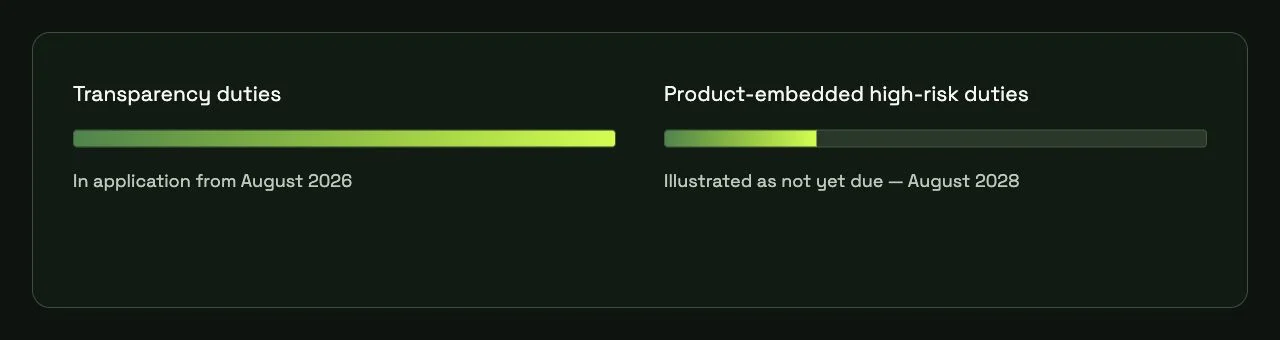
Manufacturers heard, correctly, that Europe had slipped the strictest AI duties. The European Commission’s AI Act page explains the slip. A simplification package, the AI Omnibus, was proposed in November 2025, politically agreed on May 7, 2026, and entered into force on July 27, 2026. High-risk systems used in sensitive areas — biometrics, critical infrastructure, education, employment, migration, asylum, and border control — apply from December 2, 2027. Systems integrated into products such as lifts or toys, the Commission’s examples for the product track, apply from August 2, 2028. The Commission says the delay is meant to line the rules up with standards and support tools companies can actually use.
The same page keeps an earlier date in force. Transparency rules come into effect in August 2026. Chatbots should disclose that a person is talking to a machine. Generative systems should make synthetic content identifiable. Deepfakes and certain public-interest text need visible labels. A machine builder that also runs a customer portal, a distributor chatbot, or a marketing image pipeline picked up those duties on August 2, 2026, even if the safety controller inside the machine waits until 2028.
The product file and the machine law have been told to stop duplicating
One Omnibus change is aimed squarely at factories. The Commission says the interplay between the AI Act and EU product-safety law, in particular the Machinery Regulation, has been clarified so sector rules and AI rules do not double up. That clarification is a gift only if someone on the compliance team maps it. A safety component that is also an AI system can otherwise collect two documentation piles that ask overlapping questions in different vocabularies. The clarification does not delete either pile. It tells the company to stop writing both from scratch.
Other Omnibus edits matter to mid-sized builders. Simplified technical-documentation options that had been aimed at smaller firms extend to small mid-caps. Access to regulatory sandboxes, including an EU-level sandbox, widens. A new prohibition, on AI systems that generate non-consensual intimate imagery or child sexual abuse material, applies from December 2026. Most machine builders will never design such a system. Their distributors’ marketing tools still need a content rule so a generated image cannot wander into that prohibition by accident.
Employment tools do not get the product delay
A robotics firm is also an employer. CV-sorting and worker-management tools are on the Commission’s high-risk examples, and the sensitive-use date is December 2, 2027, not the product date of August 2028. A company that postponed “AI compliance” to the machine’s conformity assessment has not postponed the hiring tool. Logging, human oversight, and data-quality duties on that tool arrive on the earlier date.
Standards are the reason the Commission gives for the extra time. High-risk duties are supposed to arrive when harmonised standards and support tools exist, which is an admission that a conformity file written today would be guessing at the technical specification. Guessing is a poor use of a regulatory engineer’s year. Using the year to label customer-facing systems, to separate employment tools from product tools, and to sketch the Machinery Regulation crosswalk is a use that does not depend on a standard that is still being written. When the standard lands, the inventory is what makes it applicable in weeks rather than in a panic.
The practical program for a manufacturer through 2027 is therefore smaller than a full high-risk conformity file and larger than a press statement about the Omnibus. Inventory every generative system that faces a customer, a worker, or the public, and apply the labeling and interaction rules now, using the Commission’s transparency guidelines. Map safety-related AI against the Machinery Regulation so the eventual AI Act file does not repeat it blindly. Pull employment tools onto the 2027 calendar even if the product calendar says 2028. The delay is real. It is not a delay of the duties that already started.