
On April 16, 2026, the MIT Center for Transportation and Logistics described its 2026 State of Supply Chain Omnichannel Report with a title that leaves little room: AI is “not optional anymore.” The underlying lab work, directed by Eva Ponce, finds 81 percent of organizations experiencing ongoing e-commerce growth and 60 percent implementing full omnichannel distribution, a 10-point increase from the year before. Customers want faster deliveries and more reliable ones. Ponce’s line on the lab’s podcast, quoted in the write-up, is that the operational side then needs much more precision.
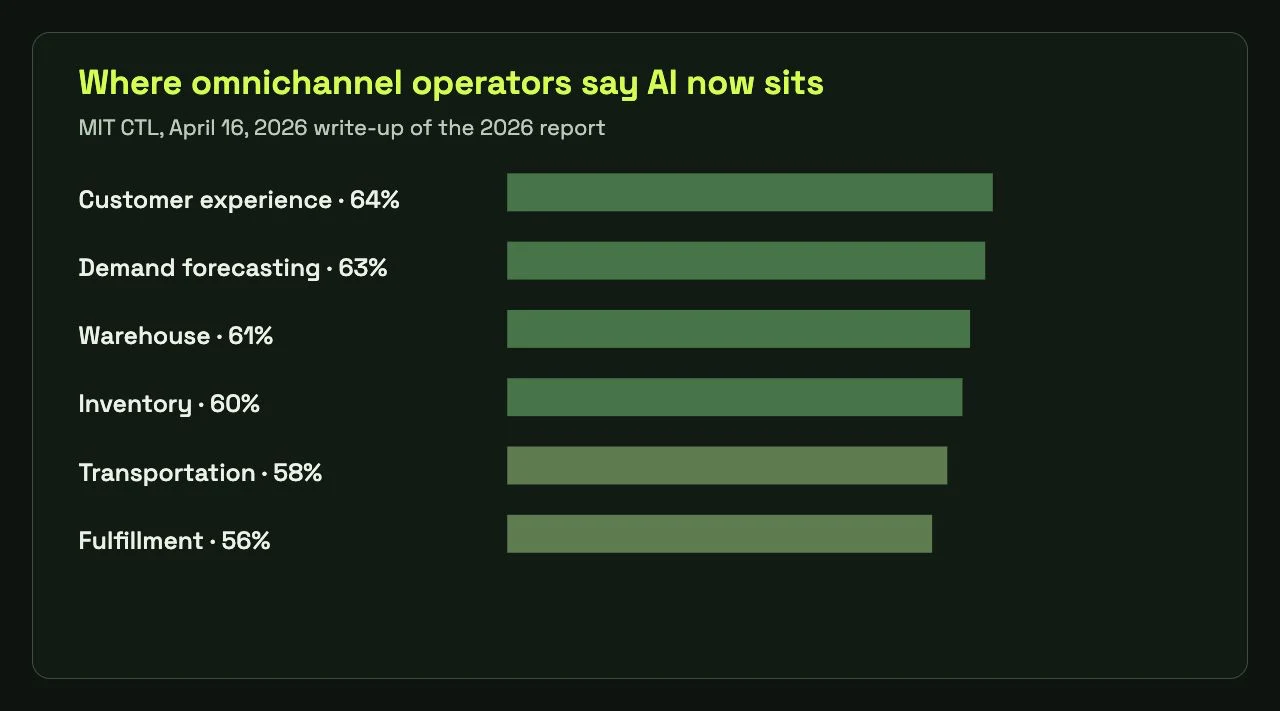
The function list is the evidence that AI has left the pilot slide. Customer experience, 64 percent, including LLM chat at 48 percent, generative copilots at 41 percent, and product recommendations at 66 percent. Demand forecasting, 63 percent. Warehouse management, 61 percent. Inventory management, 60 percent. Transportation, 58 percent. Fulfillment, 56 percent. The write-up says the year’s shift is away from demand planning alone and toward the warehouse, inventory, and transportation — the places where profitability is won or lost once the order exists. Personalization is pulling operations with it: 69 percent use AI for personalized campaigns, 66 percent for recommendations, 66 percent for segmentation, up from 37 percent the year before. Sixty-five percent report a greater need for real-time availability. Sixty-three percent cite higher inventory-accuracy requirements. Thirty-five percent say personalization tools are helping reduce returns, in a channel where online returns run 20 percent higher than traditional retail.
A second survey asks whether anyone got paid
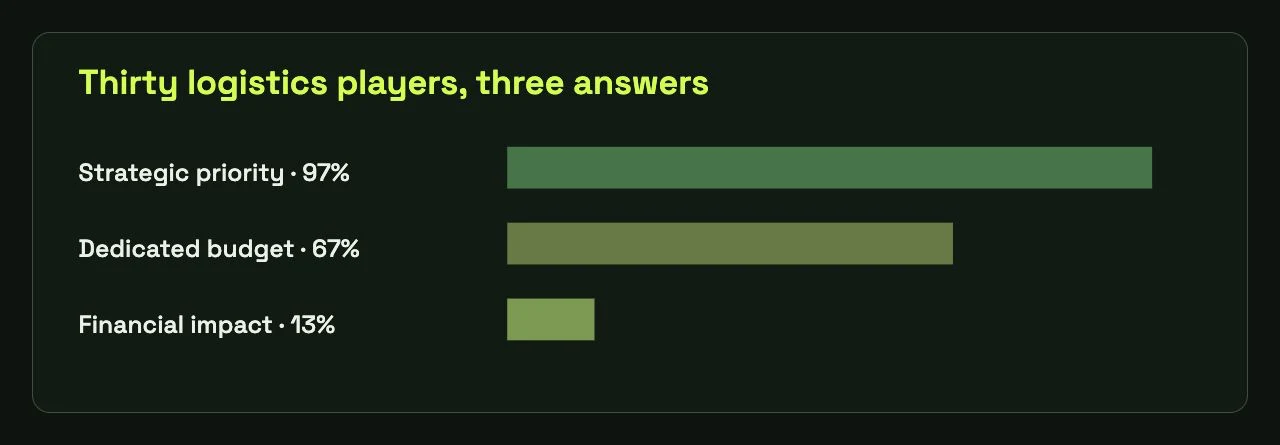
Boston Consulting Group’s August 24, 2026 article asks a different question of a much smaller group. In its 2026 AI in Logistics Executive Survey of 30 leading global logistics players, 97 percent rank AI as a strategic priority, 70 percent have an AI strategy, and 67 percent have a dedicated AI budget. Thirteen percent say AI is delivering measurable financial impact. The authors’ diagnosis is deployment, not the absence of tools: fragmented data, point solutions that do not share a workflow, and underinvestment in people and process. When asked for their most impactful AI solution, 80 percent of respondents pointed to a single standalone tool. Thirty-seven percent cited a lack of internal AI expertise as the primary barrier. Ninety-three percent said they already see notable risk from AI-native entrants.
Read MIT and BCG together without forcing them to be the same sample. MIT’s report is about shippers and omnichannel operators embedding functions. BCG’s is about logistics providers and whether the P&L moved. Both can be true. A retailer can have forecasting models and mobile robots in the building — MIT says autonomous mobile robots were highly relevant to 63 percent of respondents, up from 50 percent, and multi-shuttles rose from 14 percent to 56 percent — while the carrier that moves the goods still cannot point to a financial result. The integration problem lives on the boundary between those two companies as much as inside either one.
What to connect, rather than what to buy next
BCG’s estimate of industry profit — a roughly 5-point EBITDA margin lift and about $250 billion, built off a $5.5 trillion revenue figure the firm attributes to GSCi — is the firm’s expectation, not a result in the survey. Leave it in the “scenario” folder. The survey result to manage against is the 13 percent. MIT’s operational priorities for the year ahead are inventory accuracy, fulfillment, real-time visibility, and workforce skill. Those are connection problems. A forecast that cannot see the inventory position, and an inventory position that cannot see the robot’s queue, will keep producing the pattern both sources describe: tools in production, money still pending.
Ponce’s other quoted shift is about where the money inside the firm is going. Last year, she said, companies invested more in visibility and automation infrastructure. This year they are investing more in AI tools that try to optimize the network end to end. That is the right instinct and the BCG failure mode at the same time. End-to-end optimization is a system. A new tool on top of a broken handoff is another point solution. Logistics has finished the adoption argument. The open argument is whether the functions in the MIT chart share a workflow someone can reconcile to a P&L line.