
The U.S. Food and Drug Administration says it has authorized over 1,600 AI-enabled medical devices for marketing in the United States as of September 2026. The products help with detection, diagnosis, and treatment across a range of conditions. The agency also says something easy to skip: it does not regulate AI as such. It regulates devices, including software that meets the device definition in the Food, Drug, and Cosmetic Act.
For this briefing we downloaded the FDA’s public device list and counted it. The file contains 1,614 rows. The latest decision date in the file is June 29, 2026. Radiology is the lead panel on 1,230 rows, or 76 percent. Cardiovascular accounts for 154. Neurology accounts for 73. Every other panel combined accounts for 157. Among decisions dated in 2026, 135 of 181 rows, or 75 percent, are radiology.
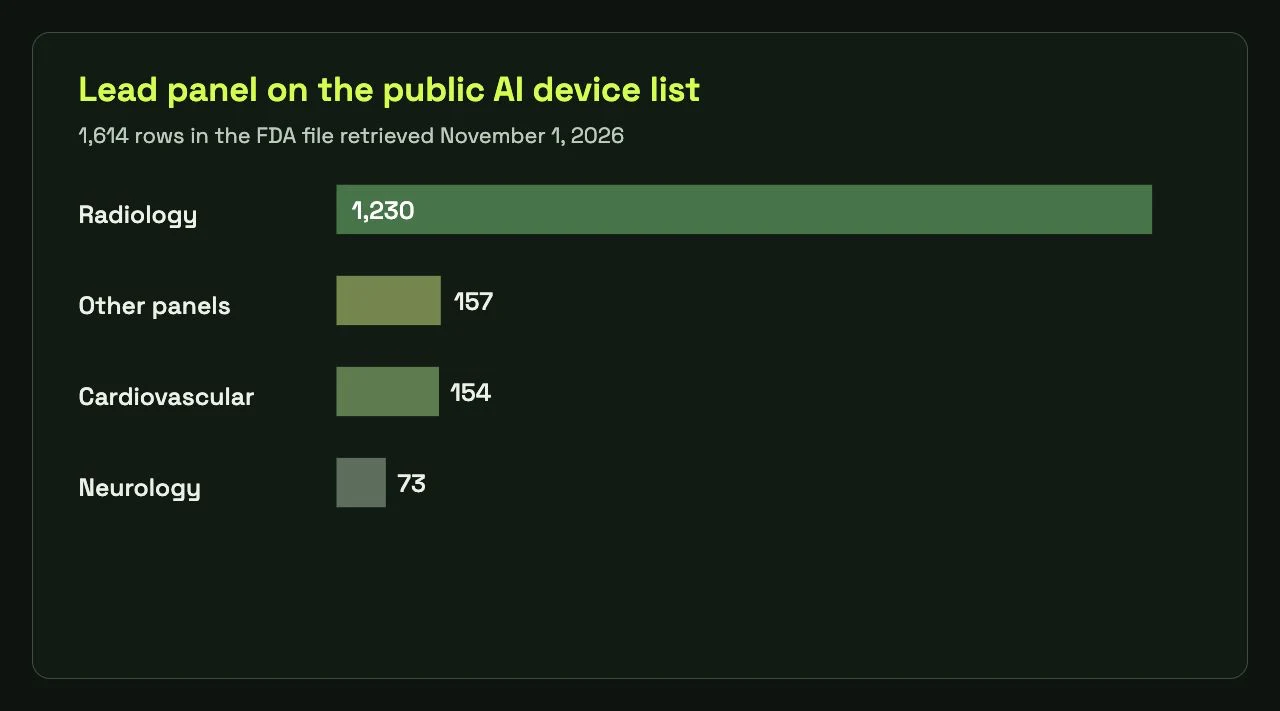
What the list is allowed to claim
Each entry has met the applicable premarket requirements. That includes a review of whether the study fits the intended use and the technology. The public database entry links to a summary of safety and effectiveness. The FDA warns that those summaries leave out most of what a sponsor filed.
The list is also, in the agency’s words, not a comprehensive resource. Devices are identified primarily when AI-related terms show up in the summary or the classification, using the FDA’s digital-health glossary. A hospital that treats 1,614 as “all the AI in the market” is reading a transparency tool with a known undercount.
The June 2026 rows at the top of the file show the same shape as the history. Philips ultrasound, Therapixel’s MammoScreen, Siemens CT, and spine segmentation software sit next to a Honeynaps sleep device cleared on June 27. Imaging is the bulk. Other specialties are present and smaller.
What the list does not settle
Marketing authorization does not decide who may turn a tool on for a given patient, what the department watches after go-live, or whether a foundation model is inside the product. The FDA has said it will explore methods to tag devices that incorporate foundation models, from large language models to multimodal systems, and it is asking sponsors to put the relevant facts in public summaries so a later update can find them.
Lifecycle questions are already on the agency’s desk. CDRH points hospitals and sponsors to predetermined change-control plans, draft lifecycle guidance, and work on real-world performance. Those documents exist because a cleared model still changes: data drift, site shift, and software updates are ordinary, not exotic.
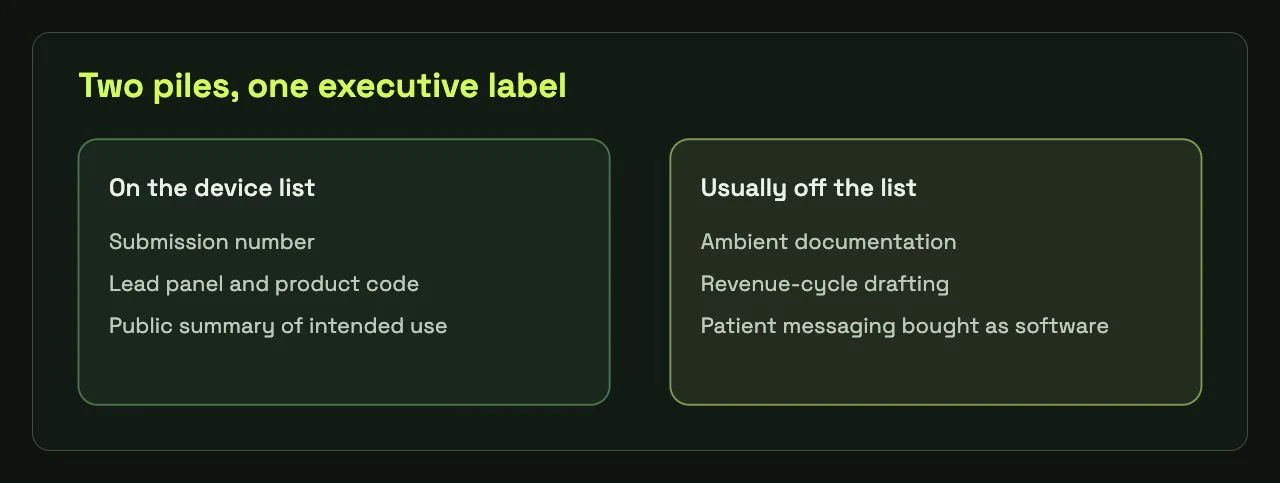
The management task
A useful inventory is local. List every AI function the system actually runs. Mark which ones have an FDA submission number. For those, copy the intended use out of the public summary and refuse the habit of stretching it. For the rest, name an owner for error, a log, and a sentence patients can understand.
The file also shows how recently the curve steepened. Decision dates in 2022 account for 162 rows, 2023 for 226, 2024 for 235, and 2025 for 335, the largest year in the download. The 181 rows dated 2026 run only through June 29, so that year is a partial count sitting inside a September page update. A planning assumption that “the list is roughly stable” does not survive those years. What stays stable is the mix. In this file, radiology accounts for more than 70 percent of the rows in every year from 2020 through the partial 2026 count.
Stanford HAI’s 2026 AI Index gives medicine its own chapter and, in the report’s top findings, pairs fast capability with a measurement lag: documented AI incidents rose to 362, from 233 in 2024, and safety-benchmark reporting remains uneven. A radiology department does not manage itself with that global tally. It does need to keep the clearance spreadsheet and the monitoring program in separate folders.