
Operators of power, water, transport, and communications systems are used to buying equipment against a standard that already has a number. Artificial intelligence is arriving in that world through a different door. On April 7, 2026, the National Institute of Standards and Technology released a concept note for an AI Risk Management Framework profile on trustworthy AI in critical infrastructure. The profile, NIST says, will guide operators toward specific practices when they take on AI-enabled capabilities. It is a concept note. It is not yet the profile.
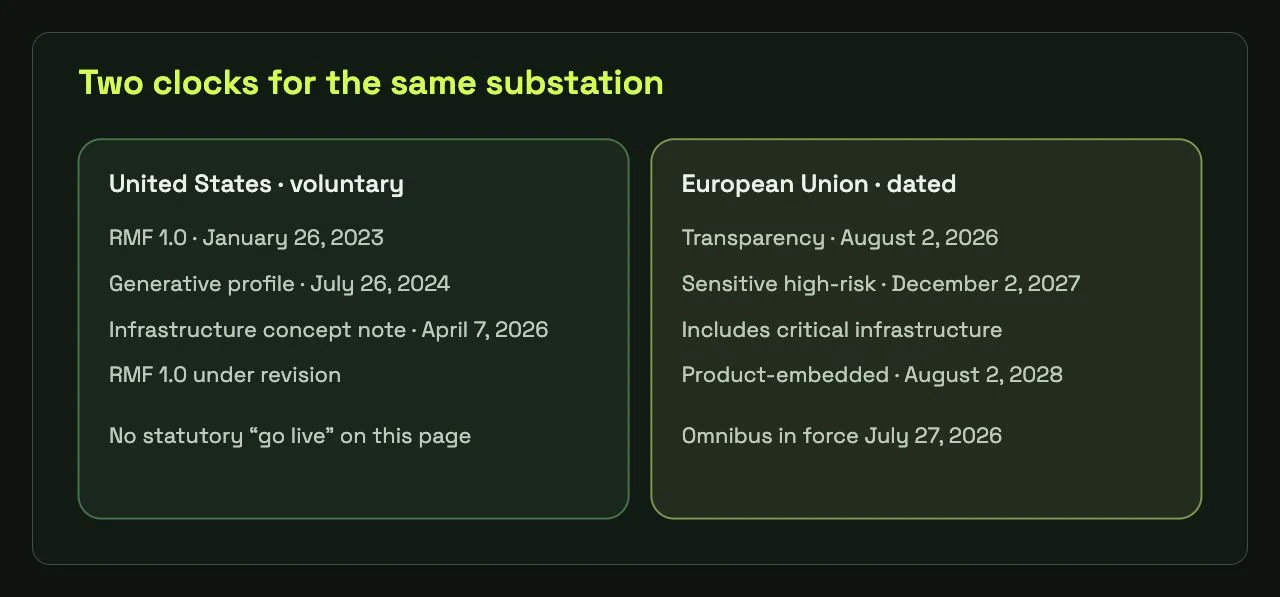
The base document operators already know is still AI RMF 1.0, released January 26, 2023, after a public process of drafts and workshops. It is voluntary. A generative-AI profile, NIST AI 600-1, followed on July 26, 2024. NIST now says AI RMF 1.0 is being revised as part of the White House AI Action Plan. An operator who froze policy on the 2023 text is about to be overtaken by a revision and by a sector profile that is still in concept form. An operator who waits for the final profile before writing procurement language will spend the waiting period signing contracts anyway.
Europe has dates, not just a draft
The European Commission lists AI safety components in critical infrastructure — transport is the example it gives — among high-risk uses, where failure could put lives and health at risk. After the AI Omnibus, rules for high-risk systems in sensitive areas including critical infrastructure apply from December 2, 2027. The obligations the Commission lists for that class are the familiar ones: risk management, data quality, logging, documentation, information for the deployer, human oversight, and robustness, cybersecurity, and accuracy. Product-embedded high-risk systems have until August 2, 2028.
A transatlantic operator therefore has two clocks. In the United States, the near instrument is a voluntary framework under revision, plus a concept note aimed at the sector. In the European Union, a statutory date is on the calendar for sensitive high-risk uses, and transparency duties are already in force from August 2026. Contracts written this year will still be in force on December 2, 2027. The profile does not have to be final for the contract to quote its questions.
What to put in the purchase order now
The concept note’s job, as NIST describes it, is to point operators at practices specific to AI-enabled capability. Until the profile exists, the durable core is the RMF’s own purpose: identify risks to individuals, organizations, and society, and build trustworthiness into design, development, use, and evaluation. A critical-infrastructure contract can ask for that in operational language without pretending the concept note is a control catalog.
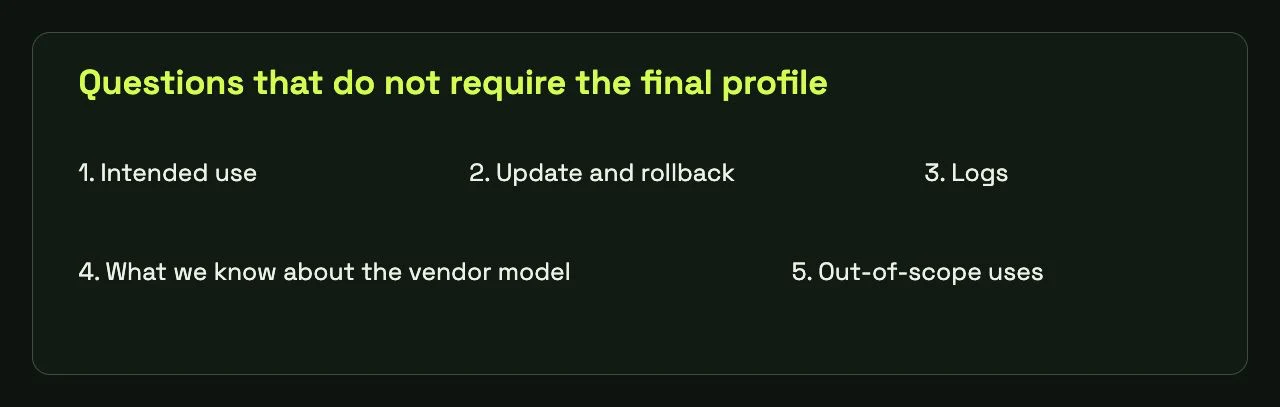
Useful asks are boring. What is the intended use, and what uses are out of scope? What happens when the model is updated? Who can roll the update back? What is logged, and for how long, if an output contributes to a switching decision or a maintenance deferral? Which third party hosts the model, and what does the operator actually know about it? The Bank of England’s 2026 financial survey, covered elsewhere in this briefing, found deep knowledge of high-materiality third-party systems at 24 percent of respondents and vendor assurance at 81 percent. Infrastructure buyers should expect the same gravity. The default answer from a vendor will be an assurance letter. The contract is the place to ask for something closer to evidence.
Public trust is part of the operating environment, not a side essay. The AI Index reports that, among surveyed countries, the United States recorded the lowest trust in its own government to regulate AI, at 31 percent, and that the EU is trusted more than the United States or China to regulate AI effectively. An infrastructure operator does not fix that number. It does live with it. A voluntary U.S. profile will be judged in public by whether the lights stay on and the explanations exist, while a European date will be judged by inspectors. Writing the contract to satisfy the stricter of the two questions is the unglamorous way to use the year the profile is still a concept.