
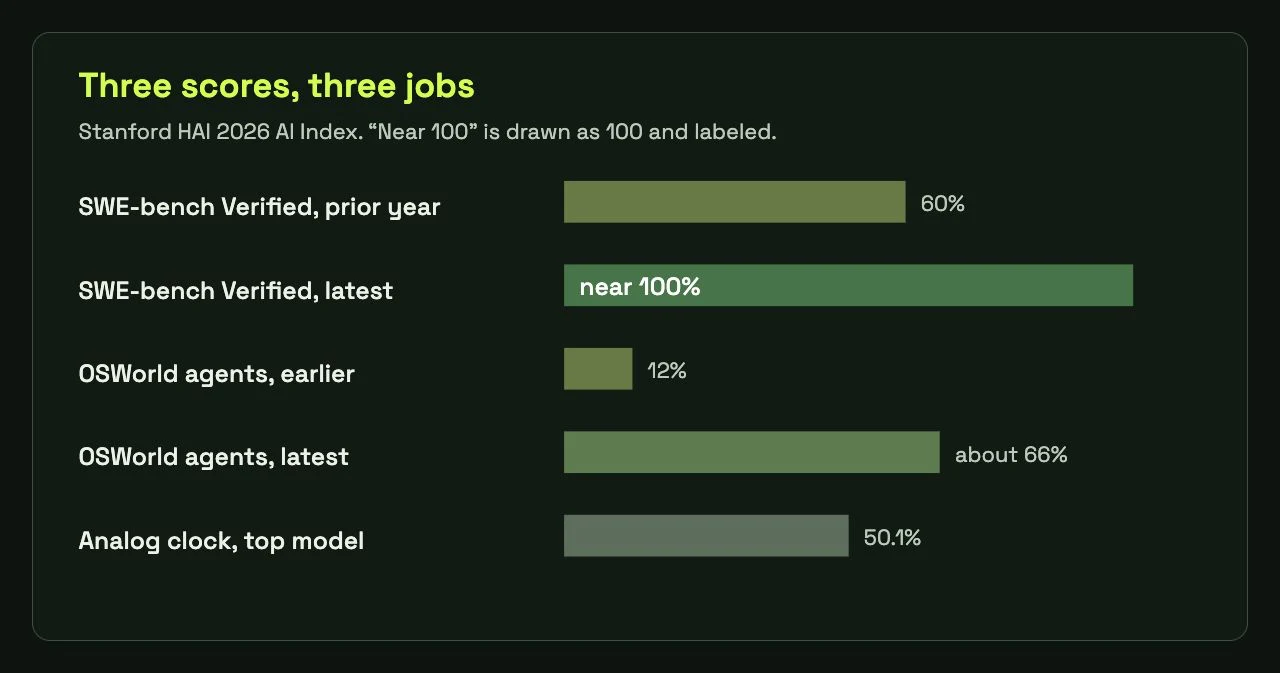
Software teams have spent two years being told that the benchmark is the roadmap. The 2026 AI Index, from Stanford’s Institute for Human-Centered Artificial Intelligence, gives that claim a precise and uncomfortable update. On SWE-bench Verified, a widely watched coding benchmark, performance rose from 60 percent to near 100 percent in a single year. Industry produced more than 90 percent of notable frontier models in 2025. Several of those models meet or exceed human baselines on PhD-level science questions, multimodal reasoning, and competition mathematics. Capability, the Index says, is accelerating.
The same opening findings describe what the authors call a jagged frontier. Gemini Deep Think earned a gold medal at the International Mathematical Olympiad. The top model reads analog clocks correctly 50.1 percent of the time. AI agents jumped from 12 percent to about 66 percent task success on OSWorld, a test of real computer work across operating systems, and still fail roughly one attempt in three. A team that staffs itself as if “near 100 percent on SWE-bench” means “the agent can finish the ticket” has mixed two different exams.
The review load moves; it does not vanish
A coding benchmark that sits near the human baseline changes the economics of the first draft. It does not change the economics of being wrong in production. OSWorld’s one-in-three miss rate is the closer cousin to the work of an agent that clicks through a staging environment, a cloud console, or a ticket queue. The clock result is a warning about confidence. A system can be extraordinary on a contest math problem and ordinary on a skill a person stops thinking about in childhood. Engineering managers already know this pattern from earlier tools. The Index gives them current numbers.
There is a second, quieter limit on using the model’s own explanation as a control. The October 19, 2026 editorial in Nature Machine Intelligence says frontier models are trained to solve problems step by step, in language a person can read, and that those reasoning tokens are not accurate explanations of the model’s internal computation. Monitorability — the hope that a transcript tells you why a patch was proposed — is a research problem, not a feature you can assume because the agent wrote a paragraph above the diff.
How a software organization should budget
The practical response is a split in the staffing plan. For well-specified code changes of the kind SWE-bench measures, budget for fast drafts and serious review: tests, ownership, and a person who can reject the patch. For agents that operate a computer, budget for the miss. A 66 percent task-success rate, if it held on your own work, means a supervised workflow with a clear stop, not an overnight queue of unattended changes. For anything that depends on the model “showing its work,” budget a check that does not trust the narrative. The Nature editorial is the scientific version of a rule senior engineers already recite: the comment can lie.
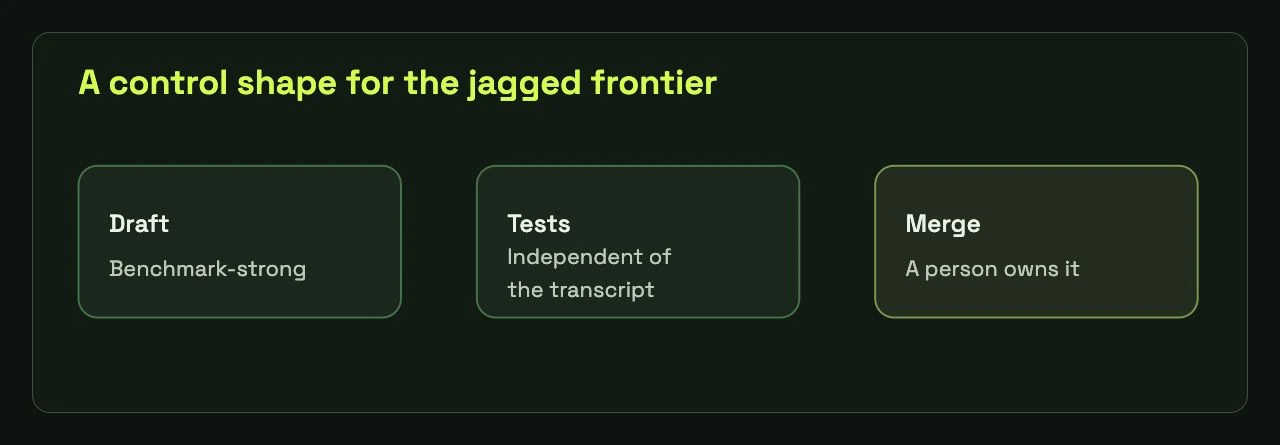
Adoption data say the tools are already on desks. The Index reports that 4 in 5 university students use generative AI, and organizational adoption reached 88 percent. The Census Bureau’s firm survey, discussed elsewhere in this briefing, finds much lower shares when the question is put to a representative sample of U.S. employers. Software companies will tend to sit at the high end of any of those cuts. The risk for them is over-reading a saturated benchmark as permission to remove the merge gate. The Index’s own phrase for the moment is the jagged frontier. The clock is still on the wall, and the best model gets it right about half the time.