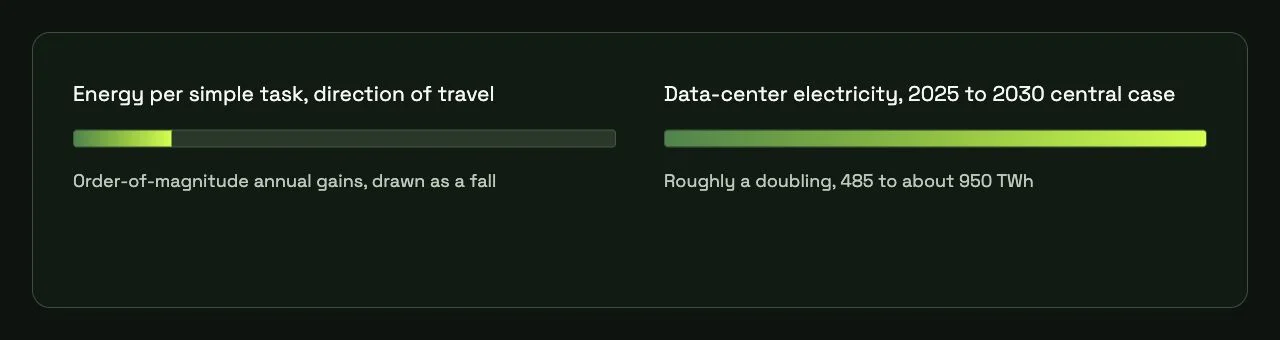
On April 16, 2026, the International Energy Agency published Key Questions on Energy and AI, a follow-up to its 2025 energy-and-AI report. The update’s central picture is easy to mis-hear if you only catch the efficiency headline. Measured per task, the agency says, AI’s energy use has been falling at a rate without a precedent in energy history. Software and hardware gains have cut energy per task by at least an order of magnitude a year in recent years. A simple text query now typically uses less electricity than a television running for the same stretch of time. If every conventional web search were replaced by a simple AI text query, the agency estimates the electricity would be under 4 terawatt-hours a year, less than 1 percent of current data-center consumption.
The same pages explain why that good news does not retire the grid problem. New uses — video generation, reasoning, agentic tasks — can consume hundreds or thousands of times more energy per query than simple text. Demand is the product of three moving parts: efficiency, uptake, and the changing mix of tasks. Major model providers, the IEA notes, reported a threefold rise in active users and a fivefold rise in revenue over the past year. There are still no comprehensive statistics on how often, or how deeply, people use the tools.
The load that planners can already see
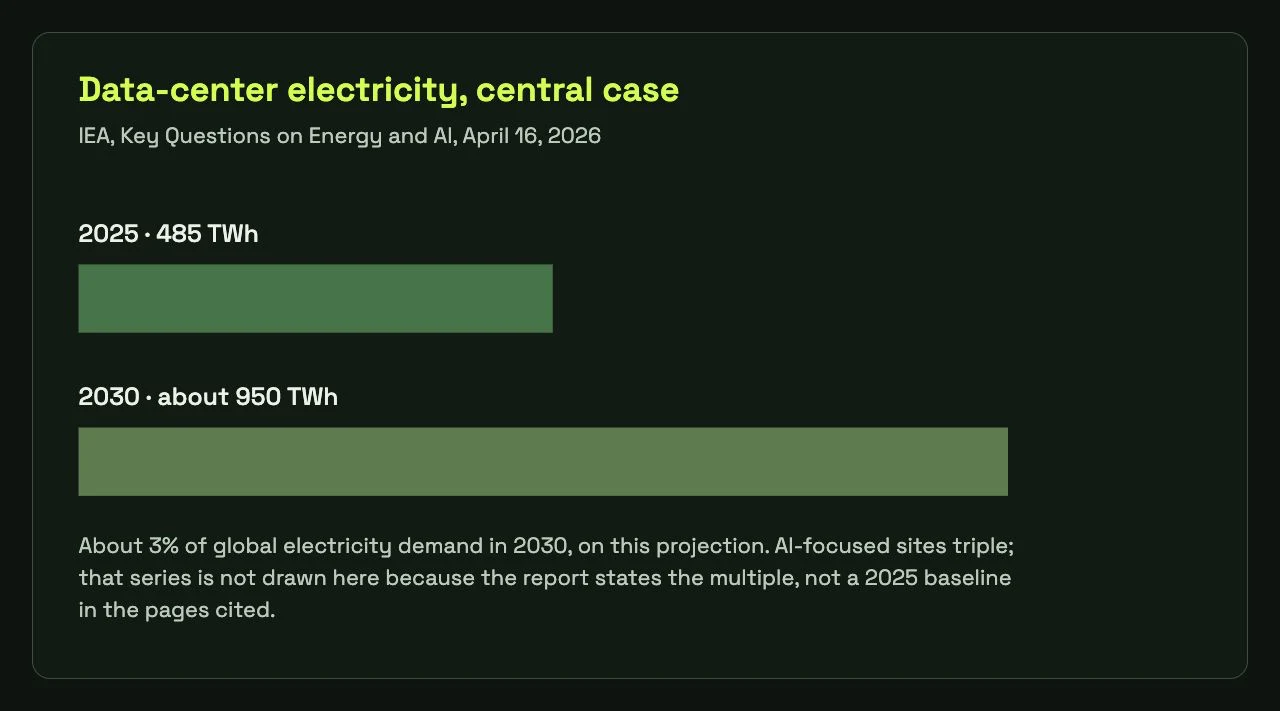
Global data-center electricity demand grew 17 percent in 2025, in line with the IEA’s earlier projection. Electricity use at AI-focused data centers grew faster, up 50 percent in 2025, well ahead of a 3 percent rise in global electricity demand. Consumption from all data centers went from a base the agency now puts at 485 terawatt-hours in 2025 toward a central projection of about 950 terawatt-hours in 2030, around 3 percent of global electricity demand. AI-focused centers are projected to triple over that span. The agency’s press note adds the capital context: capex at five large technology companies exceeded $400 billion in 2025 and is set to rise a further 75 percent in 2026.
Bottlenecks are doing some of the rationing
The report’s near-term message is constraint, not a smooth doubling on a spreadsheet. Supply chains for gas turbines, transformers, advanced chips, and other IT equipment tightened over the past year. The project pipeline is straining planning systems and holding up grid connections. Those frictions are why the IEA says aggressive near-term scenarios are less likely even while investment and the project queue boom. Further out, if equipment and chip bottlenecks ease and energy-heavy uses spread, the agency sees room for a higher path after 2030. It plans to keep revising the outlook.
Efficiency and bottlenecks can both be true. A query that gets cheaper invites more queries, and a query that reasons or makes video is a different object from the cheap text query in the television comparison. An enterprise that standardizes on agents — tools that take many model calls to finish one job — has chosen the heavy end of the IEA’s range, whatever the per-token chart in a vendor slide says.
What an energy buyer can do with this
A utility, a data-center landlord, and a corporate sustainability office are not looking at the same unit. The utility needs megawatts, interconnection dates, and equipment lead times. The landlord needs a contract that survives a change in chip supply. The sustainability office needs a task mix: if the company’s actual use shifts from short answers to agents and video, last year’s intensity factor will not describe next year’s bill. The IEA says closer monitoring and more systematic disclosure from technology firms would make the outlook less brittle. Eighty-two percent of respondents in a different survey — the Bank of England and FCA’s 2026 financial-sector study — said they do not report externally on the sustainability impacts of their AI use. Energy accounting inside firms is behind the load growth the IEA is already measuring.
Stanford’s 2026 AI Index puts the geography next to the watts: the United States hosts 5,427 data centers, more than ten times any other country, and consumes more energy for them than any other country. The electrons and the buildings are a U.S. concentration story. The efficiency miracle, if it continues, changes the slope. It does not move the substation that has to be built for the load already in the queue.