
The first wave of legal AI scandal was a fabricated case name in a brief. The State Bar of California’s 2026 Practical Guidance treats that failure as real and insufficient. The Standing Committee on Professional Responsibility and Conduct issued its first generative-AI guidance in November 2023. This revision replaces it. The committee writes that the California Supreme Court asked for the update specifically because agentic systems create problems the 2023 note did not have to solve.
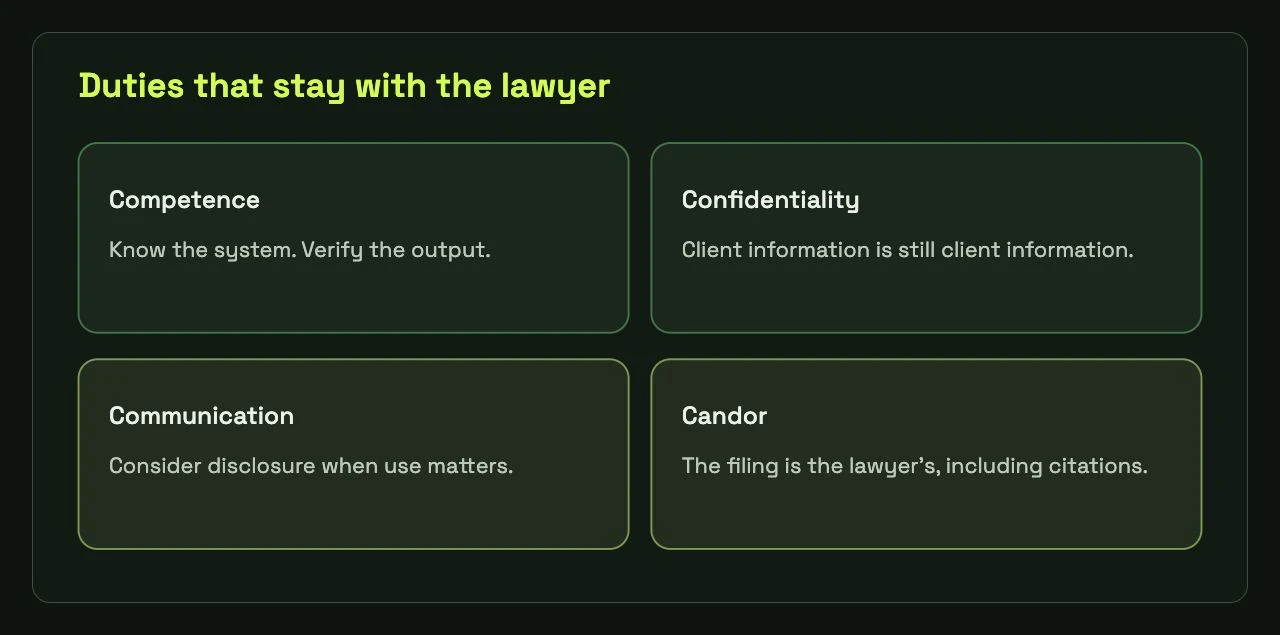
Competence, the guidance says, requires more than detecting and removing false outputs. The lawyer, not the technology, keeps strategic decisions and the exercise of professional judgment. The duty comes in two parts. The lawyer needs a reasonable understanding of the system’s capabilities, data sources, limits, and material risks before using it on a matter. The lawyer then has to review, verify, and correct the output with the skill the representation requires. Outputs can be false, misleading, fabricated, incomplete, or biased. Relying on them without that review is inconsistent with the rules.
Agency makes the old mistake faster
The guidance flags agentic tools — systems that take a longer string of actions with less real-time direction — as a place where hallucination risk compounds. Candor to the tribunal cannot be delegated. Research, drafting, summary, and analysis produced with AI remain the lawyer’s statements once they are filed. Citations have to be checked. If a court or a jurisdiction requires disclosure of AI use, including autonomous systems, the lawyer has to know that rule and follow it. Where an agent touches a filing, the lawyer has to make sure nothing goes to the court that the lawyer has not reviewed.
Communication with the client is fact-specific. The guidance says a lawyer should consider telling the client that AI will be used, how it will be used, and what the benefits and risks are. Disclosure is particularly appropriate when AI materially affects decision-making. Client instructions that limit or forbid the tools have to be followed. The existence of a research plugin does not change who is giving the legal advice.
Disclosure to the court is local
California’s note tells lawyers to check standing orders and local rules rather than assume a single national sentence. That advice matches the patchwork described by the American Bar Association’s litigation section: some states have no jurisdiction-wide rule requiring lawyers to tell the court that AI was used, while in others the obligation depends on the judge. A firm that writes one disclosure policy for every courtroom will be wrong somewhere. A firm that writes none will be wrong in the courtrooms that have already spoken.
The guidance also covers tools lawyers do not think of as AI. Research platforms, document review, and practice-management systems may include models without advertising the fact. The duty attaches to the use, not to the marketing label. A partner who banned “ChatGPT” and left the research vendor untouched has not finished the inventory.

What general counsel can copy
Corporate legal departments are not California licensees by default, but the structure travels. Name the systems, including the ones inside existing vendors. Decide which tasks may be drafted by a model and which decisions may not. Require a person to verify citations and quotations before anything external. Ask clients — internal business partners count — when a use would change how advice is produced. For agentic products that can send, file, or edit on their own, turn that capability off until the review gate is real.
The 2023 problem was a fake case. The 2026 problem, as the committee frames it at the Supreme Court’s request, is a tool that can carry a matter further before a lawyer notices. Competence now includes knowing how far the tool will go.