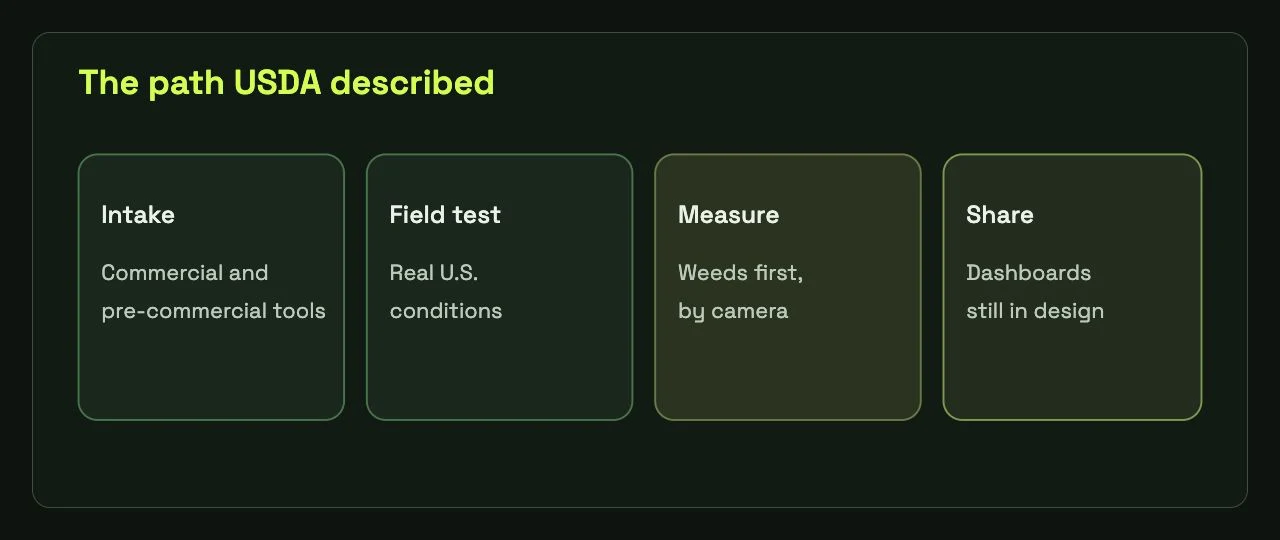
On April 7, 2026, USDA Under Secretary Scott Hutchins announced the National Proving Grounds Network for AgTech. The point of the network, in the department’s words, is to evaluate technologies under real U.S. farming and ranching conditions, “especially digital and AI-driven technologies,” so producers have performance data before they spend. The Agricultural Research Service leads it. Grand Farm, a North Dakota testbed, is the national program manager. Land-grant universities are the testing partners. Companies will be invited to enroll commercial and pre-commercial products when a request for products opens. ARS Administrator Joon Park said the agency has established a director of digital agriculture to support evaluation and deployment.
The department’s own description of the first measurement problem is weeds. Historically, people scored weed control by eye. That visual score stays as a benchmark. Computer vision and machine learning will quantify weed density and coverage before and after a precision tool runs, so the trial has a number that is not one agronomist’s glance. Disease, animal production, and water come later, each with an evaluation design still to be built. Farmers are not “joining a startup.” They are supposed to see results through dashboards, field days, and demonstrations. The specifics of that channel, USDA says on its network page, are still being developed.
The research checks are prototype-sized
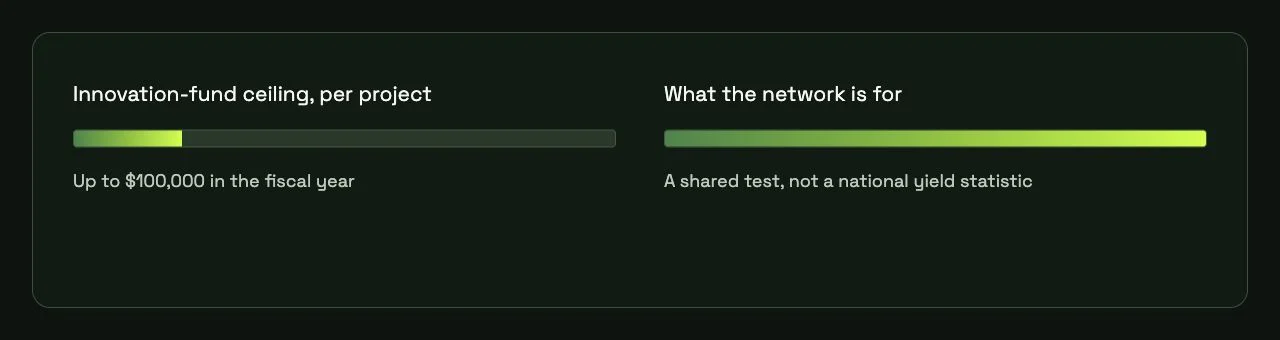
Next to the network, the ARS AI Center of Excellence funded five projects in its fiscal 2026 AI Innovation Fund. The center says the competition was tight, and that it expects in a typical year to fund four to six proposals at up to $100,000 each, spent in the same fiscal year. One funded project, $98,360, aims at an edge-vision system for common-bean seed yield and quality, with a lightweight language model writing a short description of the seed lot — uniform, market-acceptable, minimal discoloration — on top of counts a camera can defend. The deliverable is a minimum viable prototype, not a national deployment.
That scale is the story. Public agricultural AI in this funding round is a set of bounded measurement problems: seeds, pests, roots, disease, stored grain. It is not a claim that models have lifted U.S. yields. A farmer reading a vendor’s yield slide and a farmer reading the USDA release are being offered different products. One is a promise. The other is a protocol.
Why a proving ground is the enterprise story
Input sellers, equipment makers, and insurers who underwrite crop risk all profit when a tool’s performance is opaque. A public trial with a visual benchmark beside a camera count changes the sales conversation. A vendor who enrolls learns whether the tool works on the soils and weed species the network actually plants. A vendor who does not enroll will be asked, by the more careful cooperatives, why the public plot is empty. That is a slower market than a software launch. It matches the way agricultural capital is spent: a sprayer or a model is a seasonal bet, and a wrong season is not a patch you ship on Friday.
Hutchins framed the announcement around farm profitability: lower input costs, less labor, efficiency, and less risk on the purchase. None of those outcomes are reported as achieved in the release, because the network had just been created. The enterprise lesson from agriculture this year is sequencing. Build the place where a claim can fail in public. Then let the claim. A food company buying “AI agronomy” from a supplier can ask a version of the same question the proving ground asks. Where was it tested, against what visual or measured baseline, and who holds the result when the season disagrees with the brochure?