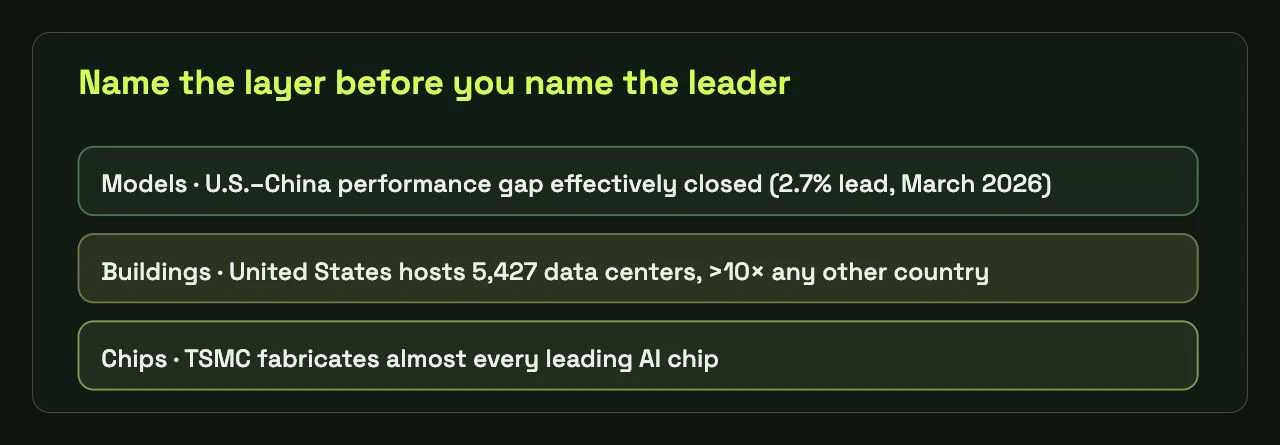
Enterprise strategy decks still open with a model leaderboard. The 2026 AI Index says that slide is the one that flattened. U.S. and Chinese models have traded the lead multiple times since early 2025. In February 2025, DeepSeek-R1 briefly matched the top U.S. model. As of March 2026, Anthropic’s top model leads by 2.7 percent. The Index calls the performance gap effectively closed. The United States still produces more top-tier models and higher-impact patents. China leads in publication volume, citations, patent output, and industrial robot installations. South Korea leads in AI patents per capita.
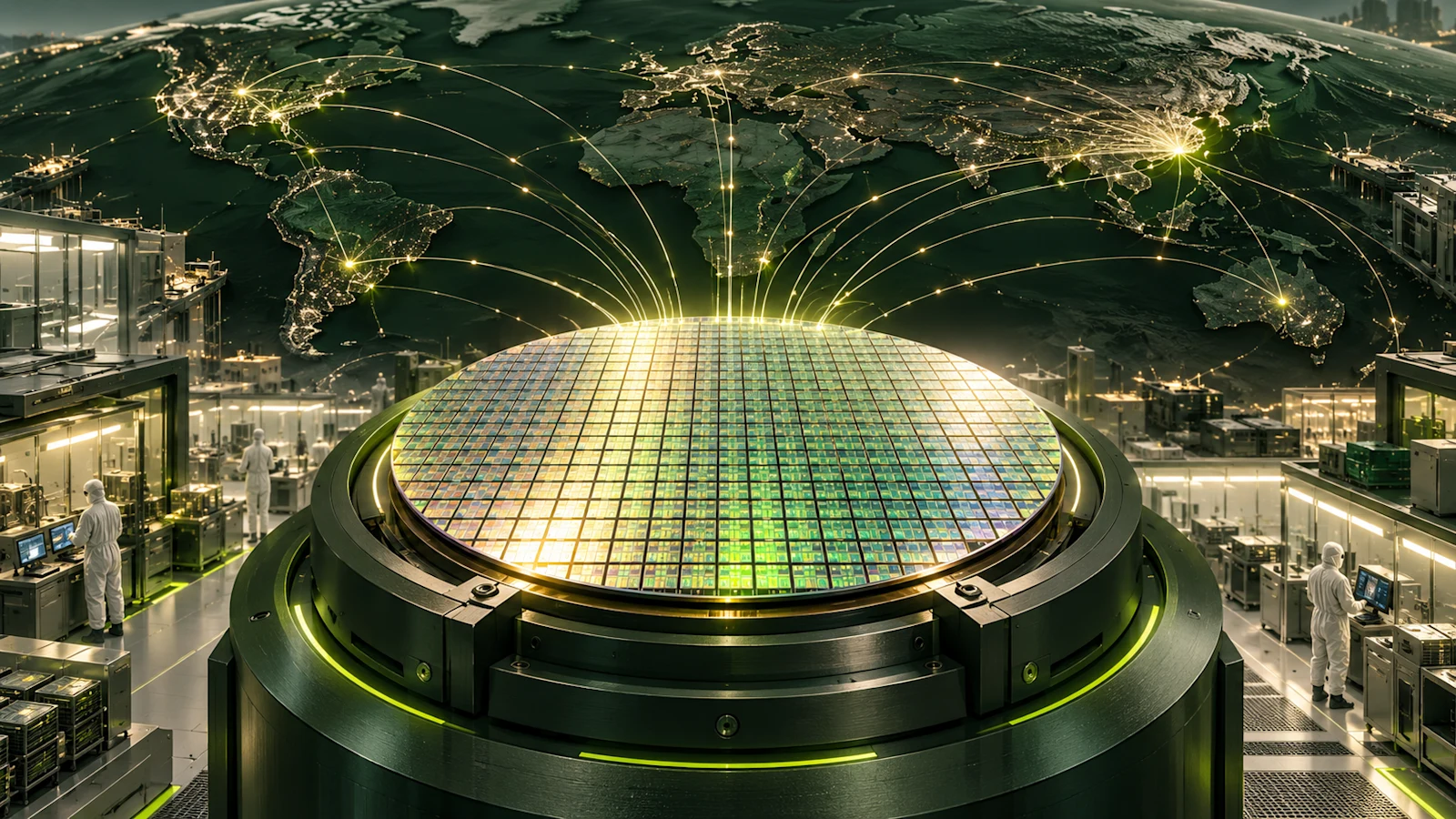
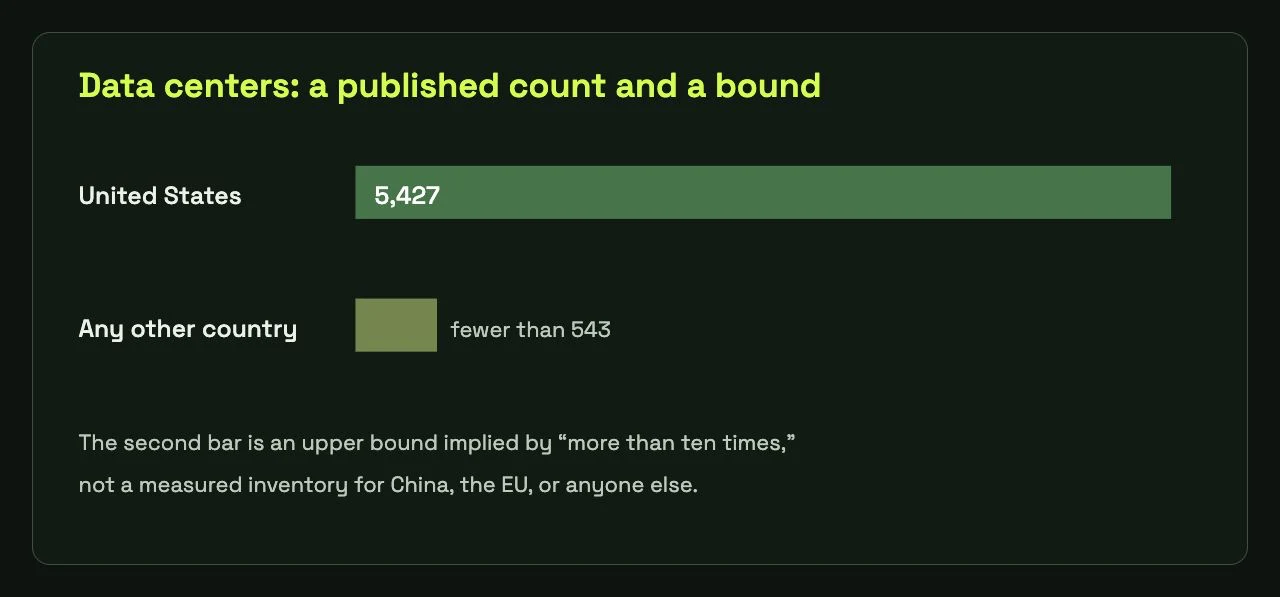
The hardware paragraph is the one a procurement officer should not skim. The United States hosts 5,427 data centers, more than ten times any other country, and it consumes more energy for them than any other country. A single company, TSMC, fabricates almost every leading AI chip. The global hardware supply chain, the Index says, depends on one foundry in Taiwan. A TSMC expansion in the United States began operations in 2025. “Began operations” is not “replaced Taiwan.” It is the start of a second site for a chain that is still singular at the leading edge.
Model parity is not a sourcing plan
A buyer who can get similar benchmark scores from more than one model vendor has gained negotiating room on the software contract. That buyer has not gained a second foundry. Training and serving the models that sit near the Index’s frontier still terminate in advanced chips, and the Index’s sentence on those chips is “almost every.” Energy concentration sits in the same paragraph: the country with the buildings also uses the most electricity for them. The IEA’s April 2026 outlook, covered in the energy briefing, has data-center demand doubling toward 2030 in the central case, with equipment bottlenecks already delaying connections. A model switch is a quarter’s work. A substation and a wafer start are not.
China’s lead in industrial robot installations is the other physical fact in the same Index finding. Software leadership and factory-floor robot leadership are not the same map. A manufacturer comparing chatbot vendors and a manufacturer comparing robot cells are reading different chapters. The Index puts both facts in one breath so that “who is ahead” has to name the asset.
Concentration also changes incident response. If a leading-edge process, a packaging step, or a shipping lane at that foundry stops, the models on the leaderboard do not become unusable overnight — inference can keep running on chips already racked — but the next training run and the next capacity addition slip together. The Index’s note that a U.S. expansion began operations in 2025 is the mitigation that exists in public. It is a beginning. Enterprises that consume capacity rather than fabricate wafers still have a question for their cloud contract: which region, which chip generation, and what happens to a reserved cluster if the upstream tool chain stalls. Multi-model routing, the software response to a closed performance gap, does not answer that question. It assumes the chips under both models keep arriving.
Energy belongs in the same review. The IEA’s April 2026 central case has data-center electricity roughly doubling by 2030, with turbines, transformers, and grid queues already slowing projects. A company that picks a model vendor this quarter and a data-center region next year is sequencing the easy decision first. The building and the foundry are the constraints that do not move on a software release train.
The enterprise response is a supply question written into the architecture review. Which model workloads require leading-edge accelerators, and which can run on last year’s parts? Where are the inference chips physically allowed to sit, given export rules and the company’s own resilience standard? If the U.S. fab is the mitigation, what share of leading-edge output does management believe it covers, and who told them? The Index does not answer the share. It answers the dependency: one foundry, a data-center map that is lopsided, and a model race that no longer picks a single winner by a wide margin. Planning as if the third fact cancelled the first two is how a software win becomes an operations surprise.